

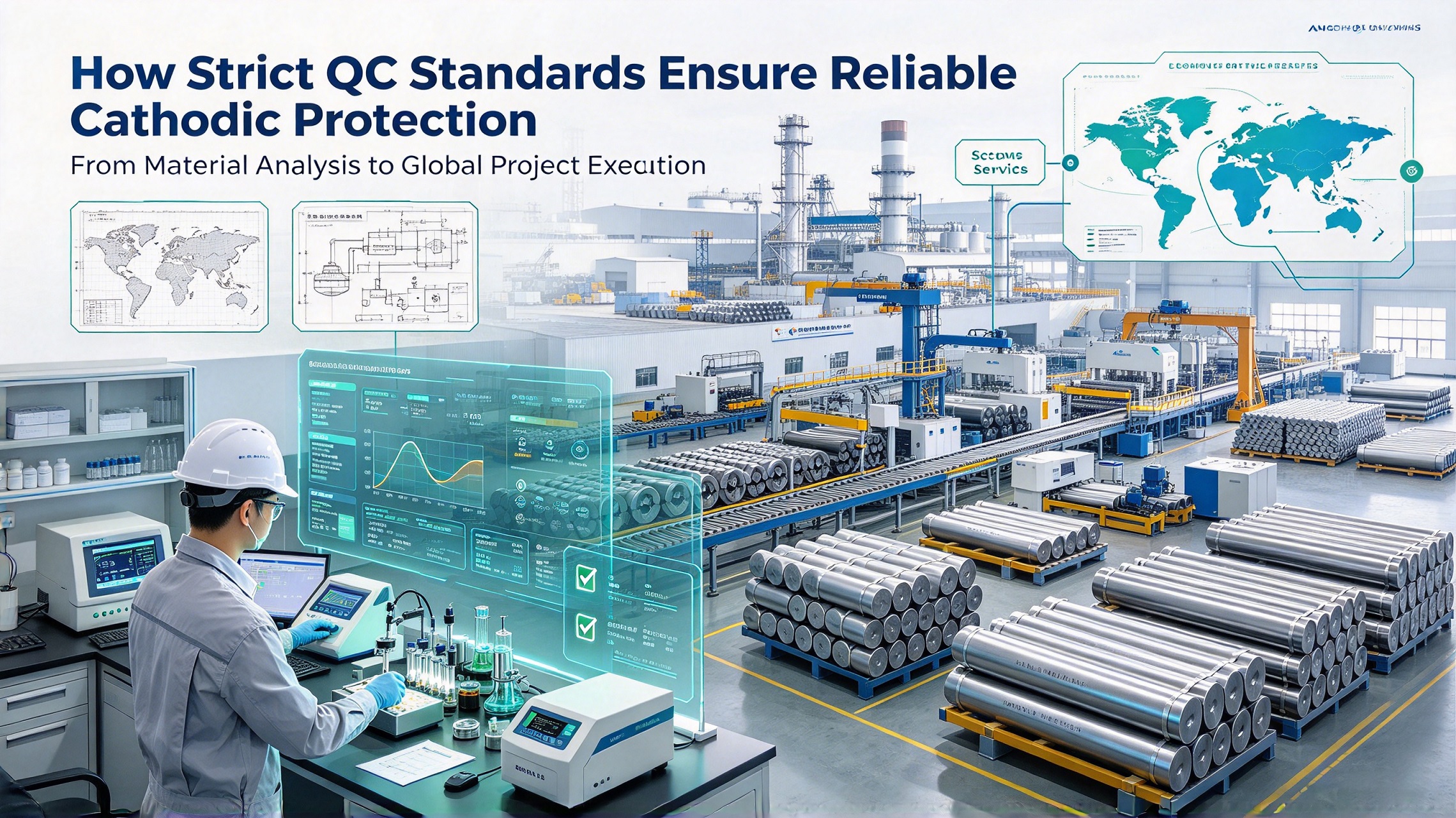
How Strict Quality Control Standards Ensure Reliable Cathodic Protection Projects
Quick answer: Anode quality control is the practice of proving, with test data rather than promises, that every anode shipped has the alloy chemistry and electrochemical performance its design assumed. For sacrificial anodes that means documented compliance with ASTM G97, ASTM B843, ASTM B418 and ASTM B179 plus in-house spectral analysis of chemical composition; for MMO anodes it means accelerated life testing against ISO 19097. Without that evidence, an under-performing anode does not fail on the pallet — it fails years later, underground, with the structure it was meant to protect.
Why Anode Quality Decides Project Lifecycle Cost
In cathodic protection, the anode is the cheapest component and the most expensive one to replace. A structure's design life is calculated from two anode properties: current output and current efficiency. If either is out of specification, the whole protection system is out of specification with it.
Three failure patterns follow from inadequate quality control:
- Chemical composition drift. Iron, nickel and copper above specification limits accelerate self-corrosion of magnesium anodes, so metal is consumed without delivering proportional protective current. Impurity levels are usually invisible to the eye and undetectable without analysis.
- Substandard electrochemical performance. An anode can have the right alloy name and still deliver far less current capacity per kilogram than the design assumed. Published evaluations of magnesium anodes have long shown efficiency varying widely between alloys and heats — a poorly performing anode can fall well short of its nominal life.
- Coating failure in impressed current systems. For MMO anodes, insufficient coating loading or a defective coating process produces accelerated consumption at the anode surface, and the failure appears as an early rise in circuit resistance and a falling protection potential.
The economic result is the same in all three cases: the asset loses protection before its scheduled inspection interval, and remediation costs include not only new anodes but excavation, downtime and re-certification. Anode quality control is therefore a lifecycle-cost decision, not a purchasing formality.
The Five Test Standards That Actually Prove Anode Quality
| Standard | Scope | What it verifies | Why it matters in a project |
|---|---|---|---|
| ASTM G97 | Magnesium sacrificial anode specimens for underground applications | Laboratory measurement of the two fundamental properties: potential and current capacity | Proves the anode will deliver rated current per kilogram in soil service, not just that it is the right alloy |
| ASTM B843 | Magnesium alloy anodes for cathodic protection (cast and extruded) | Alloy chemistry, potential and current-efficiency requirements | The reference specification for magnesium anodes in buried pipelines and grounding grids |
| ASTM B418 | Cast and wrought galvanic zinc anodes | Composition and performance requirements for zinc anodes used in seawater, brackish water and similar service | Confirms zinc anodes are specified and produced for the electrolytes where zinc genuinely works |
| ASTM B179 | Aluminium alloys in ingot form for remelting and in molten form for castings | Raw-material chemistry of the aluminium ingot that aluminium anodes are cast from | Backs aluminium anode performance to the melt stage, since anode quality starts with ingot quality |
| ISO 19097-1 / -2 | Accelerated life test method for mixed metal oxide (MMO) anodes for impressed current cathodic protection | Accelerated service-life evaluation of MMO anodes — Part 1 for concrete, Part 2 for soils and natural waters | Gives ICCP designers a service-life basis for MMO anodes instead of a supplier estimate |
Sources: ASTM G97, ASTM B843, ASTM B418, ASTM B179, ISO 19097-2.
A practical note on how these standards differ in kind: G97 is a test method while B843, B418 and B179 are product specifications. A supplier can therefore satisfy a specification and still avoid the test. Requiring both — specification compliance plus G97 test data — is what closes the gap.
How Chemical Composition Is Controlled in Production
Alloy chemistry is the first variable to control and the easiest to falsify accidentally through recycled charge material or process drift. The industry-standard control is quantitative analysis of every production batch rather than visual or weight-based inspection:
- Incoming material verification — ingot chemistry is confirmed against the applicable specification before the furnace, not after casting.
- Melt-level analysis — optical emission spectrometry (OES) or equivalent spectral analysis on samples taken during melting, compared against the alloy's specified range.
- Impurity watch — iron, nickel and copper are monitored specifically, because these elements degrade magnesium anode efficiency far out of proportion to their concentration.
- Heat traceability — each cast batch keeps a heat record, so a delivered anode can be traced to the chemistry that produced it.
- Sampling for electrochemical testing — cast anodes are sampled and tested for potential and current capacity to the applicable method (for magnesium, ASTM G97).
Spectrometry is what makes the difference between "our anodes comply with ASTM" as a statement and as evidence: the analysis is quantitative, repeatable and traceable to a batch.
How MMO Anodes Are Qualified for Long-Term Service
MMO anodes are not covered by the same logic as sacrificial anodes — they are not consumed to protect the structure, so their failure mode is coating degradation rather than metal loss. That is why qualification relies on accelerated life testing:
- ISO 19097 Part 2 applies to MMO anodes in soils and natural waters, the service condition for most impressed current groundbed installations.
- ISO 19097 Part 1 applies to MMO anodes in concrete, relevant to concrete-embedded anode systems.
- Electrochemical accelerated ageing supplements the life test by cycling the anode under controlled current density, which exposes coating defects and loading weaknesses that a short static test can miss.
For ICCP design, the test output feeds directly into the groundbed sizing calculation: usable service life at the design current density determines how many anodes the groundbed needs and how often it must be revisited.
What a Compliant QC Process Looks Like Across the Production Line
Quality control is only as strong as its weakest stage. In a compliant process, the checkpoints run the full length of the line:
- Incoming material — ingot and raw-material chemistry verified to specification (for aluminium, ASTM B179-grade ingot).
- Melt and composition — spectral analysis per batch with recorded results and impurity monitoring.
- Casting and forming — process parameters controlled and recorded for cast and extruded or wrought products.
- Dimensional and mass verification — anode dimension, core position and net mass checked, because current output per metre of pipeline depends on both mass and geometry.
- Electrochemical testing — potential and current capacity tested on sampled production, to the applicable method.
- Coating and assembly checks (MMO and pre-packaged products) — coating verification for MMO anodes, plus backfill composition, cable joint integrity and sealing checks for pre-packaged units.
- Final inspection, marking and documentation — batch identification and the release of test records with the shipment.
The seventh stage is the one buyers should care about most, because it is the one they can audit at their desk.
Documents to Request With Every Anode Shipment
| Document | What it should show | Which failure it prevents |
|---|---|---|
| Certificate of conformity | Product, standard referenced, batch number, quantity | Unverifiable compliance claims |
| Chemical composition report | Spectral analysis results versus specified range, including Fe/Ni/Cu | Composition drift and impurity-driven self-corrosion |
| Electrochemical test report | Potential and current capacity data on sampled production | Anodes that under-deliver current capacity in service |
| MMO accelerated life test report | Test method, conditions and result per ISO 19097 | Coating life assumptions that cannot be defended |
| Dimensional and mass inspection record | Measured dimensions and net mass per batch | Installation mismatch and under-mass supply |
| Cable and assembly test record (pre-packaged) | Continuity and joint quality for pre-packaged units | Cable failure at the anode, a common field failure point |
A supplier that treats these as standard attachments removes most of the buyer's specification risk. A supplier that produces them only after a claim has been raised is telling you where quality control actually sits in the process.
Why Documented Quality Matters More in the 2026 Renewal Cycle
China's industrial renewal programme has made anode documentation a project-deliverable question rather than a procurement preference. In March 2026, Chinese ministries issued an action plan to promote the renewal and renovation of ageing production equipment in the petrochemical and chemical industry (Global Trade Alert), with provincial timelines extending toward the end of the decade.
Renewed assets are expected to meet current codes rather than past practice, and inspection intervals are set against the anode system's documented design life. For project teams this changes the acceptance criteria for anode supply:
- Test data is requested at tender stage, not at delivery.
- Batch traceability becomes part of the handover pack.
- Replacement intervals are written into maintenance planning using the supplier's tested performance, so a supplier that cannot evidence performance is a schedule risk, not just a commercial one.
FAQ: Anode Quality Control and Test Standards
Which standards should a cathodic protection anode comply with? Magnesium sacrificial anodes are specified against ASTM B843 with electrochemical performance evaluated per ASTM G97. Zinc anodes follow ASTM B418. Aluminium anode quality is backed to the ingot stage by ASTM B179. MMO anodes for impressed current systems are qualified by accelerated life testing to ISO 19097.
What is the difference between ASTM G97 and ASTM B843? B843 is a product specification: it defines the alloy chemistry, potential and efficiency requirements for magnesium anodes. G97 is the test method used to measure potential and current capacity in the laboratory. Compliance with B843 is a specification claim; G97 data is the evidence behind it.
How is anode chemical composition verified? By quantitative spectral analysis — optical emission spectrometry or equivalent — on samples taken from the melt, with results compared against the specified alloy range. Iron, nickel and copper are monitored specifically because they sharply reduce magnesium anode efficiency even at low concentrations.
What does ISO 19097 actually test? It specifies the accelerated life test method for mixed metal oxide anodes for impressed current cathodic protection: Part 1 for concrete and Part 2 for soils and natural waters. The result is used to estimate service life under design current density.
What happens if an anode has unstable chemical composition? Protection falls short of design: current output drops, the structure corrodes while nominally protected, and maintenance intervals shorten. Because the failure is hidden underground or underwater, it is typically discovered during inspection — after the asset has already been exposed.
Should I accept a certificate of conformity without test data? A certificate alone only asserts compliance. For buried and offshore assets, request the batch-level chemical analysis and electrochemical test report together with the conformity certificate, so compliance is verifiable rather than asserted.
Can I mix anodes from different batches in one groundbed? Mixing is technically possible if every batch meets the same specification and documentation, but the groundbed's design life should then be based on the lowest tested performance in the set. In practice, batch-consistent supply with per-batch records is simpler to defend at handover.
How do MMO anode failures show up in service? Typically as a rising circuit resistance and a falling structure potential at constant rectifier output. The cause is usually coating degradation, which is why ISO 19097 accelerated life testing at the qualification stage matters more than any post-installation inspection.
Conclusion: Evidence, Not Assurance, Protects the Asset
Anode quality control is a chain: specification, spectral verification of chemistry, electrochemical testing of sampled production, dimensional and assembly checks, and documentation that travels with the goods. Each link converts an assumption about performance into a verified fact — and every unverified link is a lifecycle-cost exposure carried by the asset owner, not the supplier.
Xi'an AUE Technology Co., Ltd. (anodeae.com) has manufactured cathodic protection materials for more than 21 years, with complete production lines and standardized testing covering sacrificial anodes, MMO anodes and cathodic protection accessories. Our magnesium, zinc and aluminium sacrificial anodes are produced to ASTM G97, ASTM B843, ASTM B418 and ASTM B179 practice with spectral analysis controlling chemical composition, and our MMO anodes are qualified through ISO 19097 accelerated life testing and electrochemical accelerated ageing testing. Review our quality system or contact our engineering team with your project specification — we will confirm the test documentation available for your application before quotation.

