How Does Anode Quality Control Work? The Testing Standards Behind Reliable Cathodic Protection
Quick answer: Anode quality control verifies three things before any anode leaves the factory — chemical composition, electrochemical performance, and long-term durability. For sacrificial anodes, that means testing to ASTM G97 (electrochemical performance), ASTM B843 (magnesium anode composition), ASTM B418 (zinc anodes), and ASTM B179 (aluminium anodes). For MMO anodes used in impressed current systems, durability is verified by ISO 19097 accelerated life testing. Composition is controlled by spectrometer analysis during production, and every batch is inspected before shipment.
Why anode quality decides whether a project works
In cathodic protection, product quality directly determines the service life and safety of the whole anti-corrosion project. An anode whose chemical composition drifts, or whose electrochemical performance is below specification, produces insufficient protection current. The result is accelerated equipment corrosion, frequent project maintenance, and economic loss that dwarfs whatever was saved on the anode purchase price.
This is why cathodic protection design standards treat materials and equipment as part of the design — ISO 15589-1 sets requirements and recommendations covering not only pre-installation surveys and design, but materials, equipment and installation for cathodic protection of pipeline systems (ISO 15589-1:2015). An anode that cannot be shown to meet those material requirements cannot be assumed to deliver the design protection level.
The six quality control gates
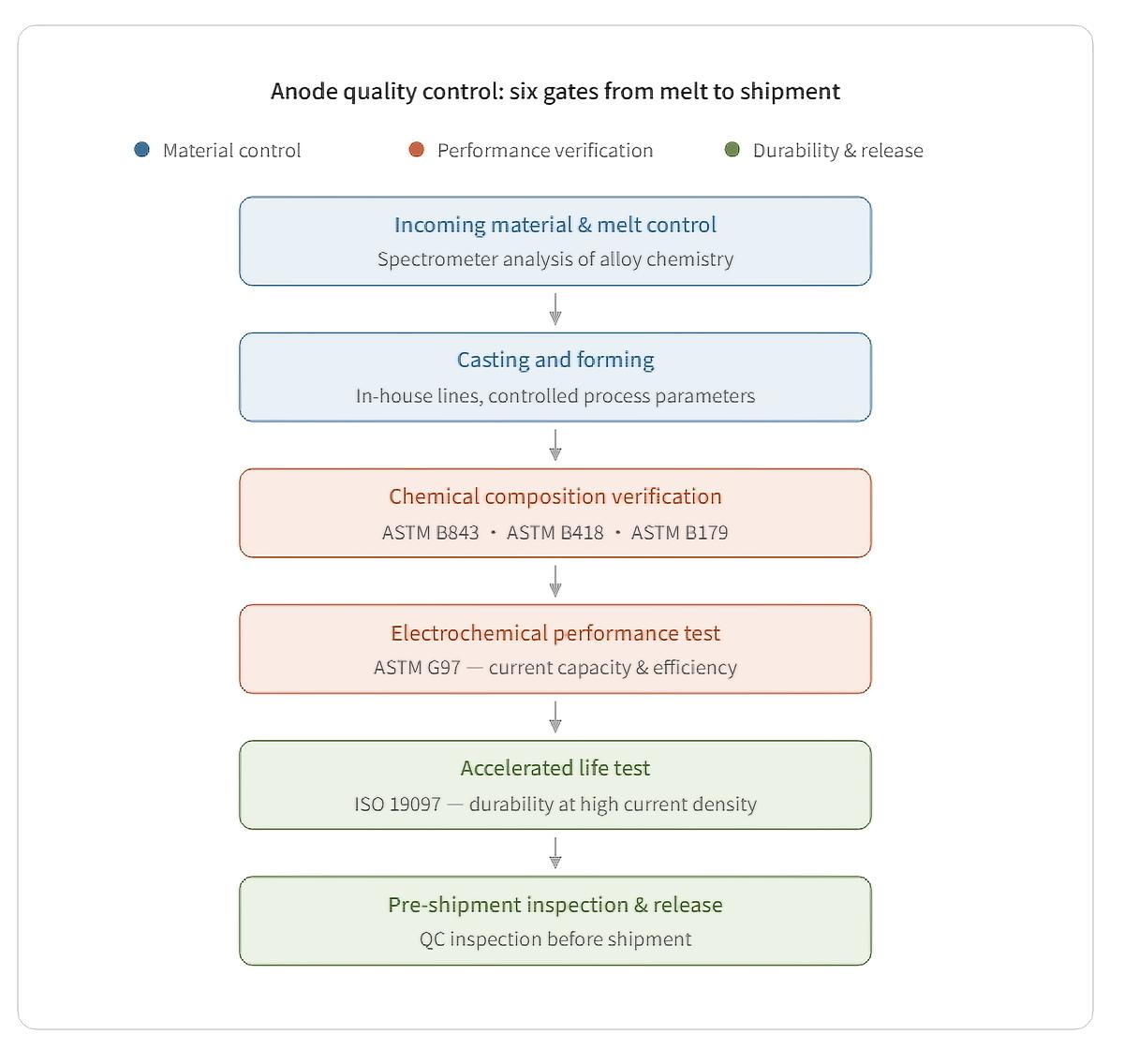
Anode manufacturing runs through six checkpoints. Each one exists because a specific failure mode is invisible at the end of the line.
![]()
1. Incoming material and melt control. Raw alloy inputs are verified before casting. Chemistry is established here, and a mistake at this stage cannot be corrected downstream — only detected.
2. Casting and forming. Production runs on complete in-house lines with controlled process parameters, so grain structure and alloy distribution stay consistent from batch to batch.
3. Chemical composition verification. Finished anode chemistry is confirmed against specification, not assumed from the melt recipe.
4. Electrochemical performance test. The anode is measured for what actually matters in service: current capacity and anode efficiency.
5. Accelerated life test. MMO anodes are aged under controlled high current density to prove durability rather than promise it.
6. Pre-shipment inspection and release. Goods are inspected before they leave, and the test record travels with the batch.
Which standard applies to which anode?
| Anode type | Standard | What it verifies |
|---|
| Magnesium sacrificial anodes | ASTM B843 | Chemical composition control of magnesium alloy anodes, confirmed by spectrometer analysis |
| Zinc sacrificial anodes | ASTM B418 | Material standard for cast and wrought galvanic zinc anodes |
| Aluminium sacrificial anodes | ASTM B179 | Material standard for aluminium alloys in ingot and molten forms |
| All sacrificial anodes | ASTM G97 | Electrochemical performance — laboratory evaluation of anode test specimens, measuring current capacity and anode efficiency |
| MMO anodes (ICCP) | ISO 19097 | Accelerated life testing of mixed metal oxide anodes to verify long-term durability |
Two notes for buyers reading a supplier's datasheet. First, material standards (B843, B418, B179) and performance standards (G97) test different things — compliance with one does not imply the other, and a datasheet that cites only the material standard has not demonstrated performance. Second, composition testing should be performed on the finished anode by spectrometer analysis, not inferred from the furnace charge.
How is anode chemical composition controlled?
Every product family is held to a specification and verified by spectrometer analysis of the finished material. Composition control matters because small deviations change behaviour disproportionately:
- Magnesium anodes — alloying elements govern the driving voltage and the anode's own corrosion uniformity. Off-specification chemistry leads to uneven consumption and premature failure rather than a gradual decline.
- Zinc anodes — alloying additions control whether the anode corrodes evenly or passivates and effectively stops working, a failure mode that produces no visible warning.
- Aluminium anodes — composition determines activation in seawater and the consumption rate, which sets how long the anode actually protects the structure.
Because these failure modes are invisible until the structure is already corroding, composition control is a preventive measure — it is the only point at which the problem is still cheap to fix.
How is anode durability proven before delivery?
For sacrificial anodes, durability is a function of mass and consumption rate, and it can be calculated from the performance data measured under ASTM G97. For MMO anodes in impressed current systems, the situation is different: these anodes are expected to operate under continuous high current density for years or decades, so their service life has to be demonstrated by test rather than calculated from mass.
That is the purpose of ISO 19097, the accelerated life test method for mixed metal oxide anodes for cathodic protection. Electrochemical accelerated life testing is carried out under controlled high current density conditions, so that performance stability and expected service life are established from measured data before the anode is installed — not assumed from a coating description.
For a buyer, the practical question is not "does the supplier claim ISO 19097?" but "can the supplier show the test condition, the duration, and the result for the batch in question?" Coatings and anode formulations vary, and an accelerated life result is only meaningful when the test conditions are stated.
What is inspected before shipment?
Every anode product and its supporting accessories pass through the same standardised testing process before dispatch. Because we manufacture both the sacrificial anode range and the impressed current range — MMO anodes, high-silicon cast iron anodes, transformer rectifiers, reference electrodes, and cathodic protection accessories — a project can be supplied with a single, consistent quality record instead of several unrelated ones.
Verifying that an installed system actually delivers protection is a separate activity, governed by measurement rather than inspection. Per ABS Guidance Notes on Cathodic Protection of Ships (2017), the accepted criterion for carbon and low-alloy steel in aerated seawater is a protection potential of −0.80 V or more negative measured against a suitable reference electrode. Meeting that criterion depends on anodes that perform to specification — which is exactly what the six gates above are designed to guarantee.
Testing alone is not enough: lifecycle support
A test certificate proves a batch; it does not design a system. Alongside manufacturing, Anodes (Xi'an AUE Technology Co., Ltd., anodeae.com) provides R&D, engineering design, construction guidance, and technical consulting, with NACE / AMPP-certified engineers preparing and reviewing cathodic protection designs. From pre-sales scheme customization through to after-sales technical support, a 24/7 online sales team and engineering team back project execution — the model that has kept our anodes and CP solutions in service with customers in more than 120 countries.
Frequently asked questions
What standards should I require from an anode supplier? For sacrificial anodes: chemical composition to ASTM B843 (magnesium), ASTM B418 (zinc), or ASTM B179 (aluminium), plus electrochemical performance to ASTM G97. For MMO anodes: ISO 19097 accelerated life testing. Ask for the test record for the specific batch, not a general certificate.
What is ASTM G97 and why does it matter? ASTM G97 is a laboratory test method for evaluating sacrificial anode test specimens that measures the two fundamental performance properties of an anode in service — current capacity and anode efficiency. It answers the question "how much protective current will this anode actually deliver?", which is the number a cathodic protection design calculation depends on.
What is ISO 19097? It is the international standard for accelerated life testing of mixed metal oxide (MMO) anodes for cathodic protection, with parts covering different application environments. It exists because MMO anodes are specified for continuous high-current operation over long service lives, so durability must be demonstrated under accelerated conditions rather than inferred.
Why does anode composition matter so much? Because composition drives behaviour, and small deviations produce disproportionate failures. Off-specification magnesium chemistry causes uneven consumption; off-specification zinc can passivate and stop working entirely; aluminium composition sets the consumption rate that determines service life. None of these failures are visible before installation.
Do you test accessories as well as anodes? Yes. Standardised testing covers all anode products and their supporting accessories — transformer rectifiers, reference electrodes, junction boxes, and CP accessories — so a complete system carries a consistent quality record.
How do I verify the test data a supplier gives me? Ask for three things: the standard cited and the specific test performed, the batch or heat number the result applies to, and traceability between the certificate and the delivered goods. A supplier who can connect a certificate to a specific shipment is showing you a process; one who cannot is showing you a document.
Bottom line
Anode quality control is not a certificate — it is six verifiable gates: material and melt control, casting, composition verification, electrochemical performance testing, accelerated life testing, and pre-shipment inspection. Sacrificial anodes are verified to ASTM G97 with composition controlled to B843, B418, and B179; MMO anodes are proven by ISO 19097 accelerated life testing. Anything less leaves the design's protection level as an assumption.
If you are specifying anodes for a project and need the standards, test conditions, and batch records laid out for review, talk to our engineering team — we will send the documentation that matches your specification.