R & D
How Does Anode R&D Reduce Cathodic Protection Project Risk?
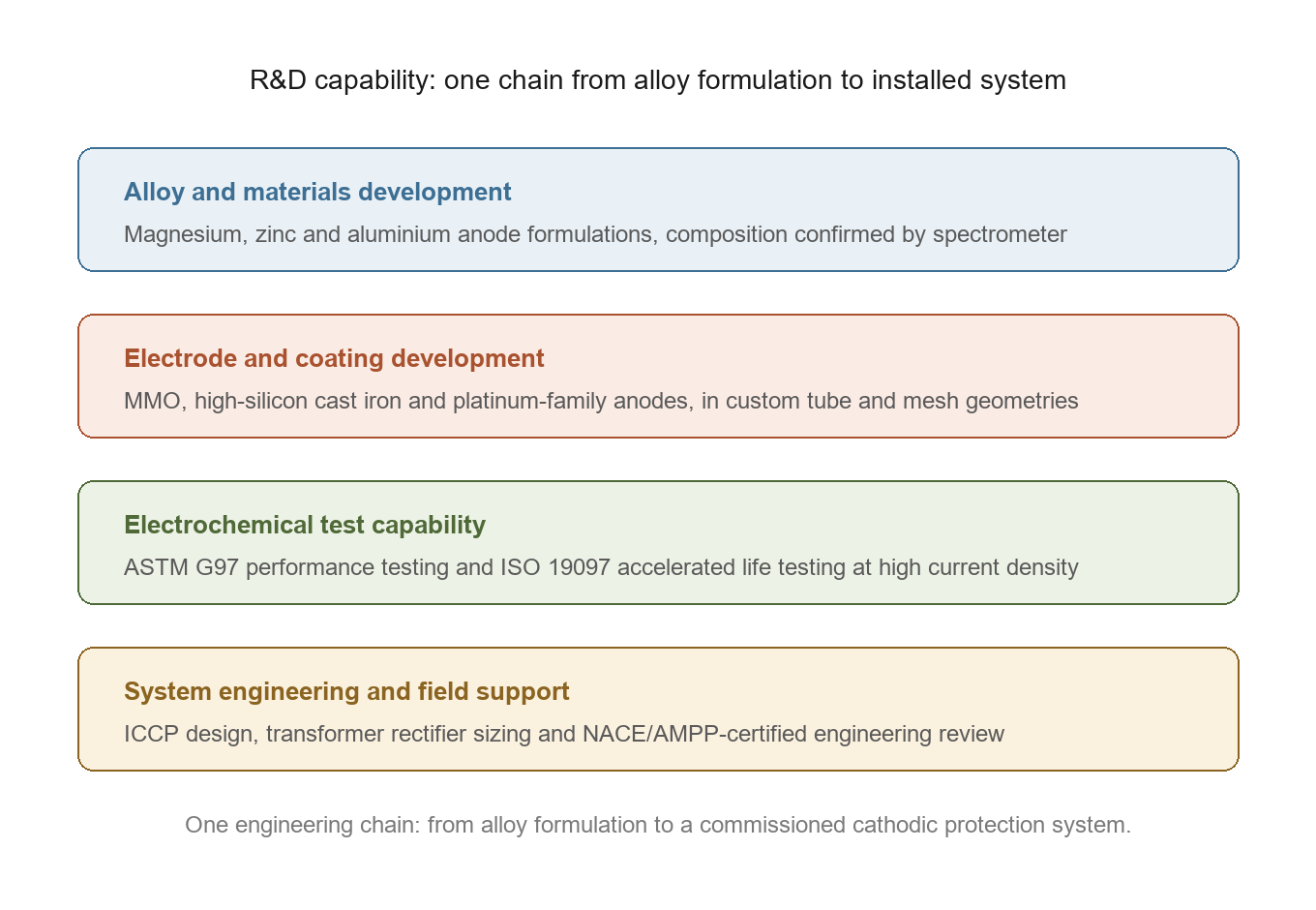
Quick answer: Anode R&D matters because every cathodic protection design assumes a protection current that the anode must actually deliver for years. Four capabilities determine whether it does — alloy and materials development, electrode and coating development, in-house electrochemical testing, and system engineering. A manufacturer who controls all four can promise performance from measured data; a manufacturer who controls none of them can only repeat a specification. Look for in-house testing to ASTM G97 and ISO 19097, spectrometer-verified composition, and NACE/AMPP-certified design engineers.
![]()
Why anode R&D is a project risk issue, not a nice-to-have
A cathodic protection design calculates the current needed to hold a structure at a protective potential, then specifies anodes that can supply that current over the design life. Every part of that chain rests on assumptions about the anode: its current capacity, its consumption rate, and how both behave in the actual electrolyte after several years of service.
If those assumptions are wrong, nothing fails immediately. The structure simply corrodes more slowly than it should, and the error surfaces years later as accelerated corrosion, unplanned inspections, and early anode replacement.
This is not a theoretical concern. Cathodic protection design criteria are themselves an area of active technical debate — a 2022 review in Materials examining current design criteria for cathodic protection notes that the choice of protection configuration depends on several factors, and that galvanic and impressed current systems trade simplicity against flexibility (A Critical Analysis on the Current Design Criteria for Cathodic Protection). Design standards such as ISO 15589-1 exist precisely because protecting a structure correctly requires controlled materials, equipment, and installation — not just a current number on a drawing (ISO 15589-1:2015).
R&D capability is what converts those assumptions into measured data. That is the practical advantage it buys a project.
The four R&D capabilities that decide the outcome
1. Alloy and materials development
The anode alloy determines the driving voltage, the current capacity, and whether the anode corrodes evenly or passivates and stops working. Developing the alloy and then holding it to specification is the first capability. It is verified by spectrometer analysis of the finished anode — composition confirmed on the part, not inferred from the furnace charge.
2. Electrode and coating development
Impressed current anodes are a coating and geometry problem. Mixed metal oxide (MMO) anodes, high-silicon cast iron anodes, and platinum-family anodes each suit different electrolytes and current densities, and the physical form matters as much as the chemistry. A manufacturer able to produce MMO anodes, high-silicon cast iron anodes, and custom geometries such as tube and mesh anodes is showing electrode development capability rather than catalogue assembly.
3. In-house electrochemical test capability
This is the capability that separates a manufacturer from a reseller. Two tests matter most:
- ASTM G97 — laboratory evaluation of sacrificial anode test specimens, measuring current capacity and anode efficiency. This is the number a design calculation depends on.
- ISO 19097 — accelerated life testing of mixed metal oxide anodes. MMO anodes are specified to run under continuous high current density for years or decades, so their durability has to be demonstrated under accelerated conditions rather than inferred from mass.
Accelerated life testing carried out under controlled high current density is what allows a service life to be stated from measurement instead of assumption.
4. System engineering and field support
Anodes do not protect anything on their own. A working system needs the current demand calculated, the transformer rectifier sized, reference electrodes positioned to monitor the structure-to-electrolyte potential, and commissioning verified against a protection criterion. For carbon and low-alloy steel in aerated seawater, ABS guidance notes give that criterion as −0.80 V or more negative measured against a suitable reference electrode (ABS, Guidance Notes on Cathodic Protection of Ships, 2017).
What in-house R&D actually changes on your project
| R&D capability | What it changes for the buyer |
|---|
| Alloy and materials development | Anode performance is specified by measured current capacity, not by alloy family name |
| Electrode and coating development | The anode geometry can be matched to your structure instead of your structure being fitted to a catalogue size |
| Electrochemical test capability | Service life is stated from accelerated test data; batch test records can be supplied with the goods |
| System engineering | The anodes, power supply and monitoring electrodes arrive sized for the same design, reviewed by certified engineers |
| Cross-domain electrochemical experience | Problems that only appear outside standard conditions can be diagnosed rather than worked around |
The last row deserves attention. Manufacturers whose work stops at anodes have a narrower diagnostic range when a project behaves unexpectedly. A manufacturer who also designs electrolysis systems recognises familiar behaviour in unfamiliar conditions.
What a broader electrochemical portfolio tells you
Anode manufacturing is one branch of applied electrochemistry. A supplier's product range is therefore a readable signal of how deep its R&D actually goes.
Anodes (Xi'an AUE Technology Co., Ltd., anodeae.com) manufactures across cathodic protection and electrolysis: sacrificial anodes in magnesium, zinc and aluminium; MMO, HSCI and custom tube and mesh impressed current anodes; and electrochemical systems including PEM electrolytic cells, sodium hypochlorite generators, and alkaline electrolytic cells. Water treatment and green hydrogen applications sit alongside pipeline, tank, marine and offshore corrosion protection.
That breadth is not decoration. Designing an electrolytic cell means controlling electrode kinetics, current distribution and material durability in aggressive chemistries — the same engineering that determines whether a cathodic protection anode survives 15 years on a hull. Over 21 years, that work has been applied for customers in more than 120 countries, supported by NACE/AMPP-certified engineers.
For structures with long design lives, the trade-off between sacrificial and impressed current protection is genuinely context-dependent: ABS guidance records that for design lives beyond 15 years, sacrificial anode systems have often been considered the most effective option for the underwater hull of offshore structures (ABS, Guidance Notes on Cathodic Protection of Offshore Structures, 2018). A manufacturer that builds both can advise on the merits of each rather than steering every project toward one product.
What should you ask a supplier about their R&D?
Ask these five questions. The answers distinguish a manufacturer from a trading company more reliably than any brochure.
- Which electrochemical tests do you run in-house, and to which standard? Look for ASTM G97 on sacrificial anodes and ISO 19097 on MMO anodes. "We test at a third-party lab" is an acceptable answer — but ask for the report.
- How is composition verified on the finished product? The correct answer involves spectrometer analysis of the anode, not the melt recipe.
- Can you supply the test record for the specific batch or heat number we receive? A certificate that cannot be tied to your shipment documents nothing.
- Who reviews the design, and what are their credentials? NACE/AMPP certification is the recognised qualification for cathodic protection personnel.
- Can you size the anode for my structure, or do I have to fit your catalogue? Anode geometry — length, section, and mass — should follow from your current demand and available mounting positions.
Frequently asked questions
What is anode R&D, in practical terms? It is the work that turns an alloy recipe or a coating formulation into a product with demonstrated performance: developing the material, verifying its composition, testing its electrochemical behaviour, and validating its durability under accelerated conditions.
Which standards should an anode manufacturer be able to test to? ASTM G97 for electrochemical performance of sacrificial anodes, ASTM B843 / B418 / B179 for composition of magnesium, zinc and aluminium anodes respectively, and ISO 19097 for accelerated life testing of MMO anodes.
Does in-house testing actually matter if third-party testing is available? It matters for iteration speed and batch control. In-house capability means a formulation can be adjusted and re-verified as a normal production activity rather than as a project. Third-party testing remains valuable as independent confirmation — the two are complementary, not alternatives.
Can an anode be designed for a specific structure? Yes, and often it should be. Anode geometry, mass and alloy follow from the structure's surface area, coating condition, current demand and the mounting positions available. A custom anode is usually the correct answer for a large or unusual structure.
Why does a manufacturer's electrolysis product range matter to a corrosion project? Because it indicates depth in applied electrochemistry. Electrode design, current distribution and material durability under aggressive chemistry are the same disciplines that determine anode performance in difficult service conditions.
What is the biggest R&D-related mistake buyers make? Accepting a material standard as proof of performance. ASTM B843, B418 and B179 define composition; they do not demonstrate that the anode will deliver the required current. Performance requires performance testing — ASTM G97 for sacrificial anodes, ISO 19097 for MMO anodes.
Bottom line
Anode R&D is not a marketing category — it is four specific capabilities: alloy and materials development, electrode and coating development, in-house electrochemical testing, and system engineering. Each one converts an assumption in your design into a measurement. Ask which of the four a supplier genuinely holds, and ask for the batch-level evidence behind the answer.
If you are specifying anodes for a structure with an unusual geometry, an aggressive electrolyte, or a long design life, send us the parameters — our engineering team will size the system from your current demand and tell you which of the two protection methods actually fits.