

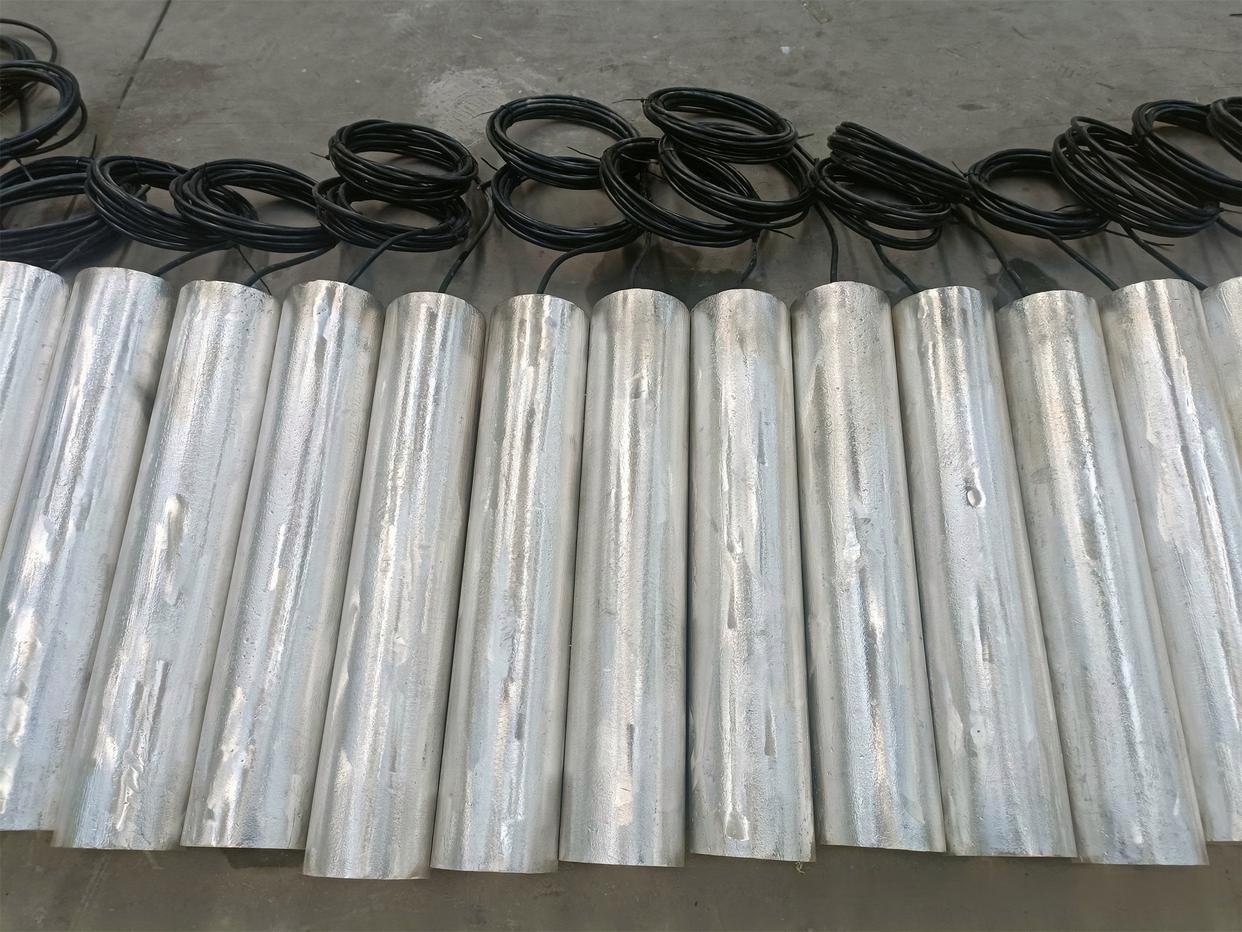
Magnesium Alloy Sacrificial Anodes With Excellent Activation
Quick answer: Activation performance is a magnesium anode's ability to reach its full driving potential quickly and keep dissolving uniformly instead of passivating. A high-potential magnesium alloy anode delivers roughly −1.75 V versus a copper/copper-sulphate (Cu/CuSO₄) reference electrode and sustains 50–55% current efficiency, which is what makes it the default choice for buried pipelines and substation grounding grids in dry, high-resistivity soil. Choose magnesium for resistive soil, aluminium for seawater and brine, and zinc only in low-resistivity electrolytes.
What "Activation Performance" Actually Means in a Magnesium Anode
Activation performance describes how readily a magnesium alloy anode gives up electrons once it is buried or immersed. Two measurable behaviours define it:
- Driving potential. The anode must reach its design open-circuit potential and hold it, not drift toward a passive value as corrosion products build up on the surface.
- Uniform dissolution. The anode should dissolve evenly across its surface. Localised attack or a passivating film increases resistance to earth and cuts the effective current output long before the anode's mass is consumed.
Magnesium is inherently the most active of the three common sacrificial metals, which is exactly why it is specified where soil resistivity is high. Standard magnesium alloy anodes (such as the AZ63 family) sit near −1.55 V versus Cu/CuSO₄; high-potential magnesium grades reach approximately −1.75 V versus Cu/CuSO₄. That extra 0.2 V of driving voltage is what pushes protective current through dry, rocky or sandy backfill hundreds of metres of pipeline and grid conductors.
Why Alloying and Impurity Control Decide Activation
Activation is not only a matter of chemistry on paper. Two manufacturing variables govern it:
- Deliberate alloying. Manganese, aluminium and zinc additions in the magnesium matrix keep the anode surface electrochemically active so dissolution stays general rather than pitting.
- Impurity ceilings. Iron, nickel and copper are the classic enemies of magnesium anodes. Even small amounts above specification accelerate self-corrosion and depress current efficiency, so the anode is consumed without delivering proportional protective current. ASTM B843 defines the alloy chemistry, potential and current-efficiency requirements for cast and extruded magnesium anodes used in cathodic protection (ASTM B843-18e1).
Practical consequence for buyers: an anode certificate is only meaningful when it reports alloy chemistry and electrochemical performance together. A low price per kilogram on an anode that self-corrodes quickly is not a saving — it is a shortened replacement interval.
How Activation Performance Is Verified: ASTM G97
The industry benchmark is a laboratory evaluation test rather than a field guess. ASTM G97 covers the laboratory evaluation of magnesium sacrificial anode test specimens for underground applications, measuring the two fundamental performance properties: potential and current capacity (ASTM G97-18(2022)).
In practice, a 14-day test cell measures how much current the specimen delivers per unit of mass lost, reported as current efficiency. Published work on magnesium anodes has long shown that efficiencies vary widely between alloys and even between heats, and that a poorly behaving anode can deliver a fraction of its nominal life (AMPP Materials Performance). That variability is the reason a specification should name the test method, not just the alloy name.
Magnesium vs Zinc vs Aluminium: Which Sacrificial Anode for Which Environment
| Anode type | Open-circuit potential (reference) | Typical current capacity | Where it belongs | Typical failure mode when misapplied |
|---|---|---|---|---|
| High-potential magnesium | ≈ −1.75 V vs Cu/CuSO₄ | ≈ 1,100–1,230 A·h/kg (500–560 A·h/lb) | Dry, high-resistivity soil; buried pipelines; substation grounding grids | Rapid consumption and possible over-protection in low-resistivity electrolyte |
| Standard magnesium alloy | ≈ −1.55 V vs Cu/CuSO₄ | ≈ 1,100 A·h/kg | Onshore soil, water-heater and tank internals | Same as above if used in seawater |
| Zinc | ≈ −1.10 V vs Cu/CuSO₄ | ≈ 780 A·h/kg at full efficiency | Low-resistivity soil, seawater, brackish water | Passivation in high-resistivity soil — insufficient driving voltage, premature system failure |
| Aluminium (Al-Zn-In) | ≈ −1.05 to −1.10 V vs Ag/AgCl | ≈ 2,600 A·h/kg | Seawater, saline mud, harbour piles, ship hulls, brine tanks | Under-activation without correct indium/zinc activation; poor performance in dry soil |
The comparison above explains a single engineering rule: driving voltage sets what the anode can protect, and current capacity sets how long it lasts. Magnesium wins on driving voltage; aluminium wins on capacity per kilogram — roughly three times the current capacity of zinc by weight, which is why marine projects can cut both material tonnage and installation cost by moving from zinc to aluminium.
Why High-Resistivity Soil Still Means Magnesium
In the dry, high-resistivity soils of northwest and north China — and in comparable arid regions worldwide — soil resistivity frequently rules out low-driving-voltage metals. Circuit resistance is dominated by the electrolyte, so an anode that cannot supply roughly 1.5 V or more of driving voltage simply cannot push enough current to polarise a coated steel structure.
For long-distance oil and gas pipelines and substation grounding grids, that makes high-potential magnesium the standard rather than an option. The correct pairing is a high-potential magnesium anode with a low-resistance, moisture-retaining backfill, installed in a pre-packaged configuration.
What China's 2026 Petrochemical Equipment Renewal Program Means for CP Buyers
China's industrial policy is now a direct driver of anode demand. In March 2026, Chinese ministries issued an action plan to promote the renewal and renovation of ageing production equipment in the petrochemical and chemical industry (Global Trade Alert), following the wider national program of large-scale equipment renewal. Industry reporting describes coordinated plans to upgrade ageing petrochemical installations, with provincial timelines extending toward 2029 (Sxcoal).
For cathodic protection teams, three consequences follow:
- Pipeline, tank and marine-structure refurbishment projects move anode replacement forward on the schedule, sometimes by years.
- Specification scrutiny rises, because renewed assets are expected to meet current codes rather than the practice of two decades ago.
- Procurement shifts from "lowest price per unit" to "documented performance per unit", since a renewed asset's inspection interval is tied to the anode system's design life.
The Shift Toward Pre-Packaged Sacrificial Anodes
Procurement behaviour has visibly changed: pre-packaged anodes are replacing bare anodes in soil applications. A pre-packaged unit is factory-assembled — anode plus cable, sealed in a moisture-retaining backfill such as gypsum–bentonite — so the site team lowers and connects rather than mixing and tamping backfill around a bare anode.
The technical argument is stronger than the convenience argument:
- Stable chemistry around the anode. Uniform backfill means uniform local resistivity, so activation is not limited by whatever soil happens to surround the anode.
- Higher and steadier protection potential. Less resistance to earth means more of the anode's driving voltage reaches the structure.
- Longer, more predictable life. Backfill protects the anode from drying out and from aggressive native soil, which extends service life and narrows the spread between design and actual performance.
- Turnkey installation. Handover quality stops depending on how well an individual crew mixed backfill on site.
The Most Expensive Mistake: Zinc in High-Resistivity Soil
The common and costly error in cathodic protection is specifying zinc anodes in high-resistivity soil. Zinc's lower driving potential cannot polarise the structure adequately, and the anode polarises further as surface films form. The system under-protects from day one, corrosion continues on the steel, and the failure typically surfaces as coating disbondment, leak detection alarms or inspection findings — long after the installation invoice was approved.
Material matching is a design decision, not a purchasing decision. The checklist below is the one our engineering team applies with clients before a single anode is quoted.
How to Specify the Right Sacrificial Anode: A 5-Step Checklist
- Measure soil resistivity along the route and log it by depth, not as a single average for the project.
- Calculate required protective current from coating condition, structure surface area and design current density for the relevant code.
- Match driving voltage to electrolyte resistivity. High-resistivity soil → high-potential magnesium. Low-resistivity soil or seawater → zinc or aluminium.
- Specify the standard and the test. Name the alloy standard (for example ASTM B843) and require documented potential and current-efficiency data for the delivered heat.
- Choose pre-packaged units for buried work, and size the backfill and cable for the design life of the renewed asset.
At AUE, anodes for these projects are supplied against documented alloy chemistry and tested in line with ASTM/ISO practice, with magnesium, aluminium and zinc sacrificial anodes plus pre-packaged configurations available from one supplier — useful when a refurbishment programme needs consistent documentation across pipeline, tank and marine packages. Our engineering team works with project teams on material selection before quotation, which is where most lifecycle cost is actually decided.
FAQ: Magnesium Anode Activation Performance
What is activation performance in a magnesium sacrificial anode? It is the anode's ability to reach and hold a strongly negative driving potential while dissolving uniformly, rather than forming a passivating film. Good activation means the anode delivers its rated current for its rated life.
How can I verify magnesium anode activation performance before purchase? Ask for alloy chemistry and electrochemical test data. ASTM B843 defines chemistry and performance requirements, and ASTM G97 is the laboratory test that measures potential and current capacity. A supplier that cannot produce heat-level test data is asking you to accept the design risk.
Why can't zinc anodes be used in high-resistivity soil? Zinc's driving potential, approximately −1.10 V versus Cu/CuSO₄, is too low to force adequate protective current through resistive soil. The anode polarises and the structure remains under-protected, so the system fails prematurely despite correct installation.
What is the difference between standard and high-potential magnesium anodes? Standard magnesium alloy anodes deliver roughly −1.55 V versus Cu/CuSO₄; high-potential grades reach approximately −1.75 V. The higher driving voltage is preferred in dry, high-resistivity soil and for structures with degraded coating.
Do magnesium anodes work in seawater? They function, but they are the wrong economic choice. Magnesium's high activity causes rapid consumption in low-resistivity electrolytes, so aluminium anodes — with roughly three times the current capacity per kilogram of zinc and far better capacity than magnesium — are normally specified for marine and saline environments.
Are pre-packaged anodes worth the extra cost over bare anodes? For buried applications, generally yes. Factory-controlled backfill stabilises the chemistry around the anode, lowers resistance to earth, and removes on-site mixing variability, which improves both protection potential and service-life predictability.
How long does a magnesium anode last in soil? Life is governed by mass, current output and current efficiency. Two anodes of identical mass can differ substantially in service life if one has poor current efficiency, which is why efficiency data matters more than nominal weight.
How do I choose between magnesium, zinc and aluminium anodes for a refurbishment project? Start with soil resistivity and required current. Use high-potential magnesium in high-resistivity soil, zinc in low-resistivity soil and brackish water, and aluminium in seawater and brine service. Where a project spans several environments, specify each package separately instead of standardising on one metal.
Conclusion: Correct Material Matching Protects the Renewed Asset
The path to reliable cathodic protection is straightforward once the environment is defined: high-potential magnesium for high-resistivity soil, aluminium for marine and saline service, zinc where resistivity is low. Activation performance is what decides whether a magnesium anode delivers its design current for its design life, and pre-packaged units make that performance predictable on site.
Xi'an AUE Technology Co., Ltd. (anodeae.com) has manufactured cathodic protection materials for more than 21 years and supplies sacrificial anodes, MMO anodes and transformer rectifier systems to customers in over 120 countries, supported by NACE/AMPP-certified engineers and ASTM/ISO-based testing. For refurbishment programmes where material selection carries lifecycle consequences, our engineers review project conditions with you before specification is fixed. Talk to our engineering team about your soil resistivity data, or review our quality system to see how anode performance is documented.

