

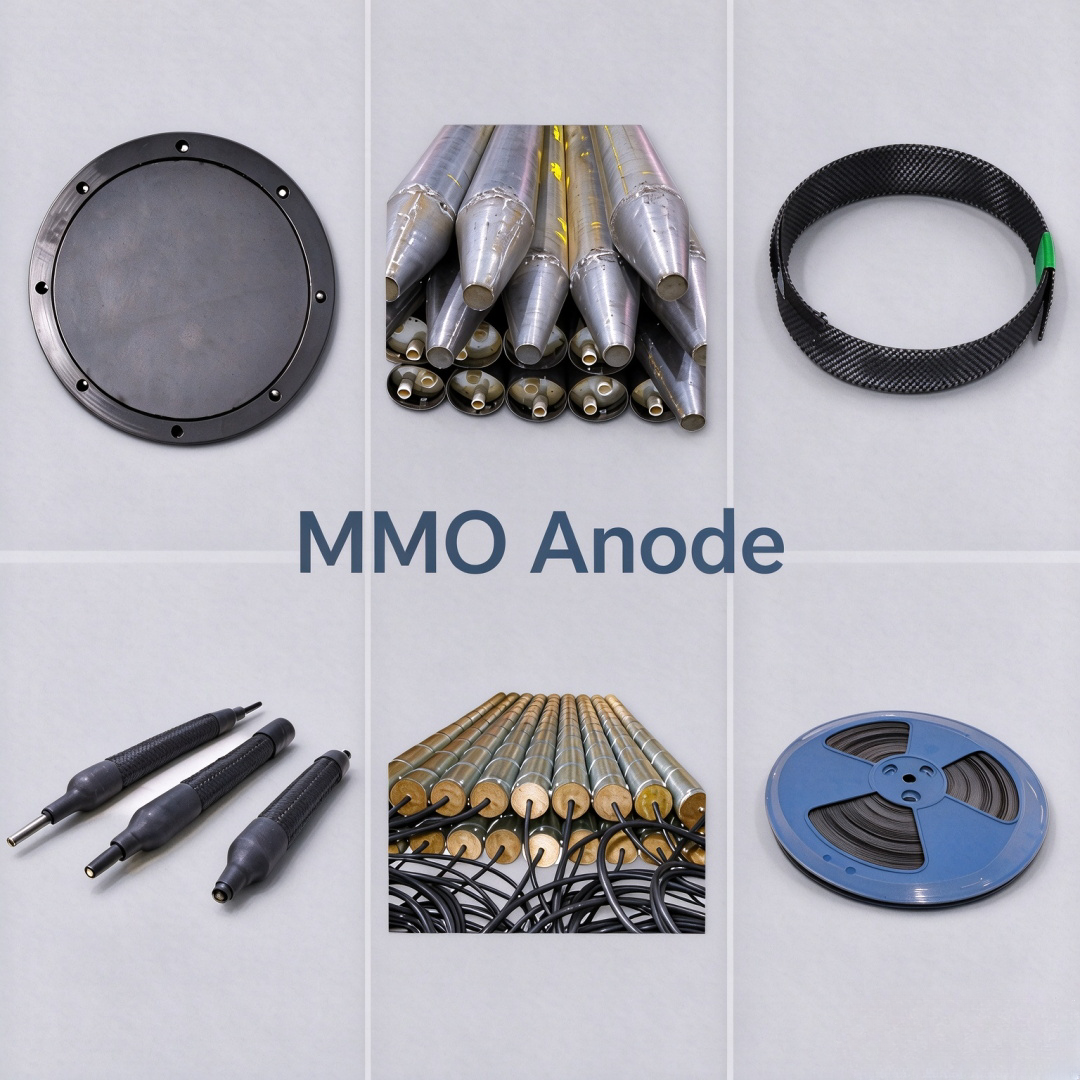
MMO Anodes: The Low-Consumption, Long-Life Core of Modern Impressed Current Cathodic Protection
Quick answer: A mixed metal oxide (MMO) anode is an ASTM B338 Grade 1 titanium substrate carrying a fired iridium-based oxide coating a few micrometres thick. It is not consumed to supply current, so its service life is set by the coating's charge capacity at the design current density — not by kilograms of metal. In a coke-breeze deep well designed at 100 A/m², a coating qualified to 3.5 × 10⁷ A·h/m² gives roughly 40 years of continuous service, against 100–500 g/A·a consumed by the high-silicon cast iron anode it replaces. That is why tubular, ribbon, wire and mesh MMO geometries now carry the impressed current load on long-distance pipelines, storage tank bottoms and offshore structures.
Key takeaways
- The coating does the work; the titanium only carries the current. Life = coating charge capacity ÷ (design current density × 8,760 h/year).
- A consumption rate quoted without a current-density basis is a marketing number. Ask for the charge capacity in A·h/m² from an accelerated life test, not a milligram figure on its own.
- Geometry follows the structure: tube for deep wells, ribbon for tank bottoms and concrete, wire for congested or irregular pipework, mesh for electrochemical plant.
- Four installation details decide whether a 30-year claim survives: coating integrity, centralisation inside the backfill, cable-joint sealing, and intimate contact with the coke breeze.
- Design current density is capped by the environment: about 50 A/m² in carbonaceous backfill, 100 A/m² in calcined petroleum coke and fresh water, 300 A/m² in brackish water, 600 A/m² in seawater.
What is an MMO anode, and why is it called a dimensionally stable anode?
An MMO anode — mixed metal oxide anode, also sold as a coated titanium anode or DSA — is a composite: a titanium current carrier with a catalytic oxide layer fired onto it. The two materials do different jobs, and understanding the split explains every performance claim in the datasheet.
The titanium substrate is industrial purity Grade 1 (ASTM B338 for tube, ASTM B265 for strip and sheet). In service it immediately grows a passive oxide film, which is why it does not dissolve anodically — and why the anode is described as dimensionally stable: its dimensions, and therefore the resistance of the anodic circuit, stay essentially unchanged from commissioning to end of life.
The coating is the active component. It is a mixed oxide of iridium with tantalum, or iridium with ruthenium and titanium, applied as a sequence of metal-salt passes and thermally decomposed in a controlled furnace. It is fully oxidised, electronically conductive — resistivity in the 10−7 Ω·m range, effectively metallic — and insoluble in the acids and alkalis encountered in cathodic protection. Because it is already in its highest oxidation state, there is no further reaction available to consume it, which is the chemical reason for its stability from roughly pH 1 to pH 12.
That is also why an MMO anode is not a painted anode. The coating is a catalyst, not a barrier: it lowers the activation energy of the anodic reaction so that oxygen — or chlorine in seawater — is evolved at a low overpotential. The practical consequence is that the anodic reaction is never the bottleneck. The bottleneck is coating life.
| Component | Typical specification | Engineering function |
|---|---|---|
| Substrate | ASTM B338 Grade 1 titanium tube; ASTM B265 Grade 1 strip | Carries current; passivates rather than dissolves; holds dimensions for life |
| Catalytic coating | IrO₂–Ta₂O₅ or IrO₂–RuO₂–TiO₂, applied in multiple thermal-decomposition passes | Catalyses oxygen or chlorine evolution at low overpotential; sets service life via charge capacity |
| Coating loading | Quoted in g/m² of noble metal (thickness figures are not comparable between suppliers) | Directly sets the A·h/m² capacity available for the design life |
| Cable joint | Centre or end connection, typically < 0.01 Ω, epoxy-potted and helium leak tested | The most common field failure point; sealing quality decides whether the anode is ever reached by current |
| Backfill (pre-packaged) | Calcined petroleum coke breeze, fixed carbon ≥ 98%, resistivity ≤ 0.05 Ω·cm | Expands the effective discharge area; lowers groundbed resistance and operating power |
For the full dimensional range and current ratings of the tubular family, see the MMO coated titanium anode specifications; the complete product range sits under MMO anodes.
Why replace high-silicon cast iron with MMO?
High-silicon cast iron was the default impressed current anode for decades, and it is still a rational choice in some shallow groundbeds. The reason MMO displaced it in deep wells, tank bottoms and offshore work is not one number — it is the combination of mass, current density and mechanical behaviour.
| Criterion | High-silicon cast iron anode | MMO coated titanium anode |
|---|---|---|
| Consumption mechanism | Anode material is consumed | Coating degrades slowly; substrate is not consumed |
| Consumption rate | Of the order of 100–500 g/A·a depending on environment | Of the order of 1–5 mg/A·a, depending on loading and current density |
| Life driver | Mass divided by consumption rate | Coating charge capacity divided by current density |
| Allowable current density | Low; output falls as the surface graphitises | High; output is limited by design basis, not by the material |
| Mass and handling | Heavy and brittle; cracks from impact and thermal shock | Light and ductile; a 25 × 1000 mm tube is a few kilograms |
| Circuit resistance over life | Rises as the anode surface deteriorates | Essentially constant — dimensionally stable |
| Best fit | Shallow groundbeds, tight budget, low current density, tolerant of periodic replacement | Deep wells, large tank farms, offshore structures, long design life, high current demand |
Two orders of magnitude separate the consumption rates, not four: the widely repeated claim that MMO wears a thousand or ten thousand times more slowly than cast iron overstates it. The real advantage is structural rather than numerical — an anode whose life is no longer proportional to its weight can be small, light and installed in a borehole, and an anode whose surface does not deteriorate keeps the groundbed resistance — and therefore the rectifier power bill — flat for decades.
Design note: consumption rate is only meaningful as a pair of numbers. A figure in mg/A·a is the mass lost per amp-year; the corresponding life requires the coating loading in g/m². Suppliers who quote one without the other are quoting a claim, not a specification.
Which MMO anode geometry fits which structure?
Four geometries cover almost all cathodic protection work. The choice is driven by how the current has to be distributed, not by preference.
Tubular MMO anodes — deep wells and high-output groundbeds
A coated titanium tube, typically 16–32 mm diameter and 500–1500 mm long, with a current rating from 2.5 A to 12 A per element. Tubes are coupled in series into an anode string with centralisers between them, then lowered into a borehole backfilled with coke breeze. This is the standard configuration for long-distance pipeline deep wells, compressor and metering station groundbeds, and anywhere surface land is unavailable or surface soil resistivity is too high for a shallow bed. Factory pre-packaging inside a galvanised steel canister is the version to specify where borehole quality cannot be guaranteed — see the pre-packaged deep well anode system, or the individual MMO tubular anode where backfill is placed on site.
Ribbon MMO anodes — tank bottoms and reinforced concrete
A coated titanium strip, commonly 6.35 mm or 12.7 mm wide and 0.6–0.9 mm thick, supplied on coils and cut to length on site. Ribbon is welded to titanium conductor strip at crossings to form a grid, then laid beneath a tank bottom liner or in slots cut into concrete cover. Its value is geometric: a line source distributes current far more evenly across a large flat area than a handful of point sources, which is exactly what a 60 m diameter tank bottom needs. See the MMO ribbon anode for cathodic protection and the field procedure in MMO titanium ribbon anodes for reinforcement in buried concrete.
Flexible wire MMO anodes — congested pipework and coating rehabilitation
A noble-metal-oxide coating on a thin titanium or copper-cored wire, jacketed so it can be run in long continuous lengths. Because it bends around elbows, flanges and pipe supports, it is the practical anode for dense process pipe racks, above-ground and buried piping with degraded coating, internal surfaces of small vessels, and any geometry where a rigid anode cannot be positioned. The flexible MMO anode is normally laid parallel to the pipe at a fixed standoff and clamped at intervals.
Mesh and canister MMO anodes — electrochemical plant and hull ICCP
Expanded mesh and disc formats serve two different masters. In electrochemical service — water treatment, electroplating, chlor-alkali, electrowinning, hydrogen generation — mesh maximises coated area per unit volume, which is why the same coating family is rated in the thousands of A/m² there. In marine service, disc and canister formats are mounted flush in hull ICCP systems and seawater boxes, where the disc anode for hull ICCP systems and the canister anode are the standard building blocks.
| Geometry | Typical section | Current distribution | Primary applications |
|---|---|---|---|
| Tubular | Ø16–32 mm × 500–1500 mm | Point source, stacked into strings | Deep well groundbeds, station groundbeds, well casings |
| Ribbon | 6.35 or 12.7 mm × 0.6–0.9 mm, on coil | Line source, welded into grids | Tank bottoms, reinforced concrete, pipe trenches |
| Flexible wire | Ø1.5–3 mm, long continuous runs | Line source, follows the structure | Congested pipework, coating rehabilitation, internal surfaces |
| Mesh / disc | Expanded mesh sheet, or disc and canister assemblies | Area source | Electrochemical plant, hull ICCP, seawater boxes |
How long does an MMO anode actually last?
Service life is arithmetic, and the arithmetic is the single most useful thing to understand when comparing quotations.
An accelerated life test measures how much charge a coating can pass before its potential rises — the ISO 19097 method — and reports the result as total charge per unit of coated area, in A·h/m². Continuous service life then follows directly:
Life (years) = Coating charge capacity (A·h/m²)
               ÷ [ Design current density (A/m²) × 8,760 h/year ]
Take a 25 × 1000 mm tube with a coated area of 0.079 m² and a working current of 8 A. The anode current density is 8 ÷ 0.079 ≈ 102 A/m². Applied to a coating qualified at 3.5 × 10⁷ A·h/m², the calculation gives:
3.5 × 10⁷ ÷ (102 × 8,760) ≈ 39 years
The same coating run harder lives proportionally shorter, and the required capacity for a fixed design life follows the same relationship:
| Environment | Typical design current density | Charge capacity needed for 25 years |
|---|---|---|
| Carbonaceous backfill | 50 A/m² | 1.1 × 10⁷ A·h/m² |
| Calcined petroleum coke breeze | 100 A/m² | 2.2 × 10⁷ A·h/m² |
| Fresh water | 100 A/m² | 2.2 × 10⁷ A·h/m² |
| Brackish water | 300 A/m² | 6.6 × 10⁷ A·h/m² |
| Seawater | 600 A/m² | 1.3 × 10⁸ A·h/m² |
This table is the reason seawater and soil specifications look so different. A coating built on a standard loading covers a 25-year life at 100 A/m² in coke breeze, but not at 600 A/m² in seawater — where the answer is either a heavier coating loading or a lower design current density with more anode area. Both are legitimate; a datasheet that quotes the maximum current density and a 20-year life without stating the loading has quietly assumed one of them.
Verification note: ISO 19097-2 specifies the accelerated life test for MMO anodes in soils and natural waters; Part 1 covers anodes in concrete. A service-life claim is only defensible when it names three things together: the design current density, the environment, and the accelerated test result. Missing any one of them makes it an estimate rather than a specification.
Which coating formulation suits which electrolyte?
Coating chemistry is matched to the anodic reaction the environment produces. The difference is not marginal: the wrong pairing trades activity for life, or life for passivation.
| Coating system | Principal anodic reaction | Suited to |
|---|---|---|
| IrO₂–Ta₂O₅ | Oxygen evolution, or mixed oxygen and chlorine | Soil, coke breeze backfill, fresh and brackish water, seawater, acid and high-chloride ground — the general-purpose cathodic protection coating |
| IrO₂–RuO₂–TiO₂ | Chlorine evolution | Seawater and chloride-rich electrolytes where high activity matters more than maximum life |
| Pt/Ti, Pt/Nb, Pt/Ta | Chlorine evolution | Specialty seawater and electrochemical duty |
Tantalum is the stabilizing element: it raises the coating's resistance to acid attack and slows the dissolution of iridium at high anodic potential, which is why IrO₂–Ta₂O₅ is the default for buried and immersed CP duty. Ruthenium raises catalytic activity but is more soluble under oxygen-evolution conditions, so Ru-rich coatings are reserved for chlorine-dominated service. Titanium in the coating adjusts structure and cost rather than performance.
What limits performance in the field? Backfill, not coating
An MMO anode's own resistance is negligible; the resistance that costs money is everything between the coating and the electrolyte. That makes the backfill a performance component rather than an installation consumable.
- Calcined petroleum coke breeze with fixed carbon ≥ 98% and resistivity ≤ 0.05 Ω·cm expands the effective discharge area many times over, which lowers groundbed resistance and the rectifier voltage needed.
- Intimate contact matters more than gradation. Voids, bridging and channelling around the anode create local hot spots where the coating is driven far above its design current density — the failure mechanism that voids the life calculation.
- Coke is consumed slowly. The backfill has its own service life; a deep well designed for 30 years needs enough coke column, not just a long-life anode.
- Water presence is required. Dry backfill stops conducting. Deep wells are normally kept watered; shallow beds in dry strata need the design to account for seasonal moisture loss.
Which installation details decide whether the service life is achieved?
Most premature MMO anode failures in the field are installation failures, and they are predictable enough to be listed.
| Rule | Failure it prevents |
|---|---|
| Protect the coating during handling and lowering. No impact, no dragging, no scratched or abraded coating; inspect every element before it goes in the hole. | A coating breach exposes bare titanium, which passivates immediately. The lost area is dead, and the remaining coating is driven at a higher current density — a double penalty. |
| Keep the string centred in the borehole. Centralisers at every joint; the anode must sit in the axis of the coke column, fully surrounded. | An off-centre string touches the borehole wall or sits against sand and gravel, concentrating current at the contact point and leaving the rest of the column under-used. |
| Seal the cable joint in two layers. Epoxy potting plus heat-shrink sleeve, with the joint mechanically supported so cable weight is not carried through it. | Moisture ingress corrodes the copper-to-titanium connection. The rectifier keeps delivering current into a joint that no longer reaches the anode, and the fault is invisible from the panel. |
| Backfill the annulus, do not bridge it. Free-flowing coke around the full length, plus a vent pipe where gas generation is expected. | Bridged or gapped backfill raises resistance and creates gas pockets that blank off coated area. |
| Bring every circuit back to a test station. Each anode string individually measurable and isolatable. | Without separability, a failing string is undetectable until the protection potential drops on the whole bed. |
Specification checklist for an MMO anode purchase
- Substrate standard and grade — ASTM B338 Grade 1 for tube, ASTM B265 Grade 1 for strip, with a mill certificate.
- Coating system and loading — IrO₂–Ta₂O₅ or IrO₂–RuO₂–TiO₂, stated in g/m² of noble metal.
- Charge capacity from an accelerated life test — A·h/m² to ISO 19097-2, with the test conditions and failure criterion.
- Design current density for your environment — stated explicitly, and consistent with the capacity above for the required life.
- Coating adhesion — bend test result, plus an X-ray or equivalent inspection of coating integrity on the delivered elements.
- Cable joint — connection resistance, sealing method, leak test, and the cable type appropriate to the electrolyte.
- Ancillaries — centralisers, canisters, coke specification, vent pipe, suspension arrangement, and factory cable length.
An ICCP system is a system: the anode, the transformer rectifier, the reference electrodes, and the test stations and junction boxes that make the installation measurable all have to be sized against the same current demand. Current distribution, rectifier rating, electrode placement and cable sizing are interdependent, and a mismatch between them is one of the more common reasons a correctly specified groundbed under-protects after commissioning. Where the project is a comparison exercise rather than a replacement, the reasoning behind choosing impressed current at all is set out in why MMO impressed current anodes suit heavy-corrosion environments, and the alternative for lower-demand sites is covered under high-silicon cast iron anodes.
FAQ: MMO anodes in impressed current cathodic protection
What does MMO stand for in an anode?
Mixed metal oxide. The term describes the catalytic coating — typically iridium and tantalum oxides, or iridium, ruthenium and titanium oxides — fired onto a titanium substrate. The substrate carries current; the mixed oxide catalyses the anodic reaction.
How long do MMO anodes last?
Twenty to forty years is the normal range, but the number only exists relative to a current density. Life equals coating charge capacity in A·h/m² divided by design current density times 8,760. A coating qualified at 3.5 × 10⁷ A·h/m² operated at 100 A/m² gives about 40 years; the same coating at 600 A/m² gives about 7. Ask for capacity, then do the division.
Are MMO anodes consumed like sacrificial anodes?
No. A sacrificial anode supplies current by dissolving, so its life scales with mass. An MMO anode supplies current by catalysing a reaction, so it is not consumed in the same sense; the coating degrades slowly through electrochemical wear, and the titanium substrate remains dimensionally unchanged. This is why an MMO anode can weigh a few kilograms and still outlast a cast iron anode weighing hundreds.
What current density can an MMO anode take?
The coating itself tolerates very high current density — the same coating family is rated in the thousands of A/m² in electrochemical plant. Cathodic protection design uses much lower figures because the limit is coating life, not catalysis: roughly 50 A/m² in carbonaceous backfill, 100 A/m² in calcined coke and fresh water, 300 A/m² in brackish water, and up to 600 A/m² in seawater, with heavier coating loading where the higher figures are used.
Does an MMO anode work in fresh water and high-resistivity soil?
Yes, and IrO₂–Ta₂O₅ is the right coating for it — it is designed for oxygen-evolution duty, which is the reaction in soil, backfill and fresh water. The constraint is circuit resistance, not the anode: in high-resistivity ground the groundbed has to be longer, deeper, or coke-backed to keep the rectifier voltage within reason.
What pH range can an MMO anode operate in?
Roughly pH 1 to pH 12 for standard IrO₂–Ta₂O₅ coatings. Below about pH 1 the titanium substrate itself becomes vulnerable regardless of coating quality, so strongly acidic service needs a different substrate — typically tantalum or niobium — rather than a thicker oxide layer.
Why do MMO anodes fail early in service?
In practice, four causes account for most early failures: coating damage during handling or installation, an anode driven above its design current density because the groundbed was designed from datasheet output rather than surface area, a cable joint that was not hermetically sealed, and backfill voids that concentrate current. Coating manufacturing defects are much rarer than installation defects.
Do I need coke breeze backfill with an MMO anode?
For buried groundbeds, yes. The backfill is what turns a small coated surface into a large effective discharge area, and it is what keeps groundbed resistance — and the rectifier power bill — low for the life of the bed. For tank-bottom ribbon and concrete embedment the electrolyte is the medium itself, so the requirement is full encapsulation in conductive mortar or native soil rather than coke.
Can MMO anodes be used alongside sacrificial anodes?
Yes, and on mixed structures it is often the right design: ICCP with MMO anodes for the large primary surfaces, sacrificial anodes in locations where power routing is impractical or where a local hot spot needs independent protection. The two systems must be electrically coordinated so that the sacrificial anodes are not driven in reverse by the impressed current.
Where MMO anodes are in service today
The applications that drove adoption are the ones where replacement is expensive: long-distance oil and gas transmission pipeline deep wells, compressor and metering station groundbeds, tank farms with bottoms measured in hundreds of thousands of cubic metres of stored product, offshore platform and jacket ICCP systems, and well casings. In each case the economics are the same — a low-consumption anode that holds its resistance lets the operator size the groundbed for the asset's design life rather than for the next maintenance window.
How AUE supports MMO anode projects
Xi'an AUE Technology Co., Ltd. (anodeae.com) has manufactured cathodic protection materials and electrochemical systems for more than 21 years, producing MMO anodes on ASTM B338 and ASTM B265 Grade 1 titanium with IrO₂–Ta₂O₅ and IrO₂–RuO₂–TiO₂ coating systems in tubular, ribbon, wire, disc, canister and mesh geometries, and supplying complete ICCP packages — transformer rectifiers, reference electrodes, test stations and junction boxes — to projects in more than 120 countries.
Coating adhesion, coating integrity and service life are qualified by bend testing, X-ray inspection and accelerated life testing, so the life figure quoted for a project is tied to a measured charge capacity rather than to a catalogue assumption. The testing regime is described in our quality system and certification and compliance documentation.
Send our engineering team your groundbed type, soil resistivity or water conductivity, chloride level, required current and design life, and we will confirm the anode geometry, coating loading, current-density basis and rectifier rating for the project. Contact us to start that review.
Standards and references
- ISO 19097-1 — Accelerated life test method for mixed metal oxide anodes: Part 1, anodes in concrete
- ISO 19097-2 — Accelerated life test method for mixed metal oxide anodes: Part 2, anodes in soils and natural waters
- ASTM B338 — Standard Specification for Seamless and Welded Titanium and Titanium Alloy Tubes for Condensers and Heat Exchangers
- ASTM B265 — Standard Specification for Titanium and Titanium Alloy Strip, Sheet and Plate
- NACE SP0572 — Design, Installation, Operation and Maintenance of Impressed Current Deep Anode Beds
- ISO 15589-1 — Cathodic protection of pipeline transportation systems: on-land pipelines
- DNV-RP-B401 — Cathodic Protection Design (offshore structures)
- AUE, Why MMO impressed current anodes are used for heavy-corrosion environments
- AUE, MMO coated titanium anode specifications and coating types

