

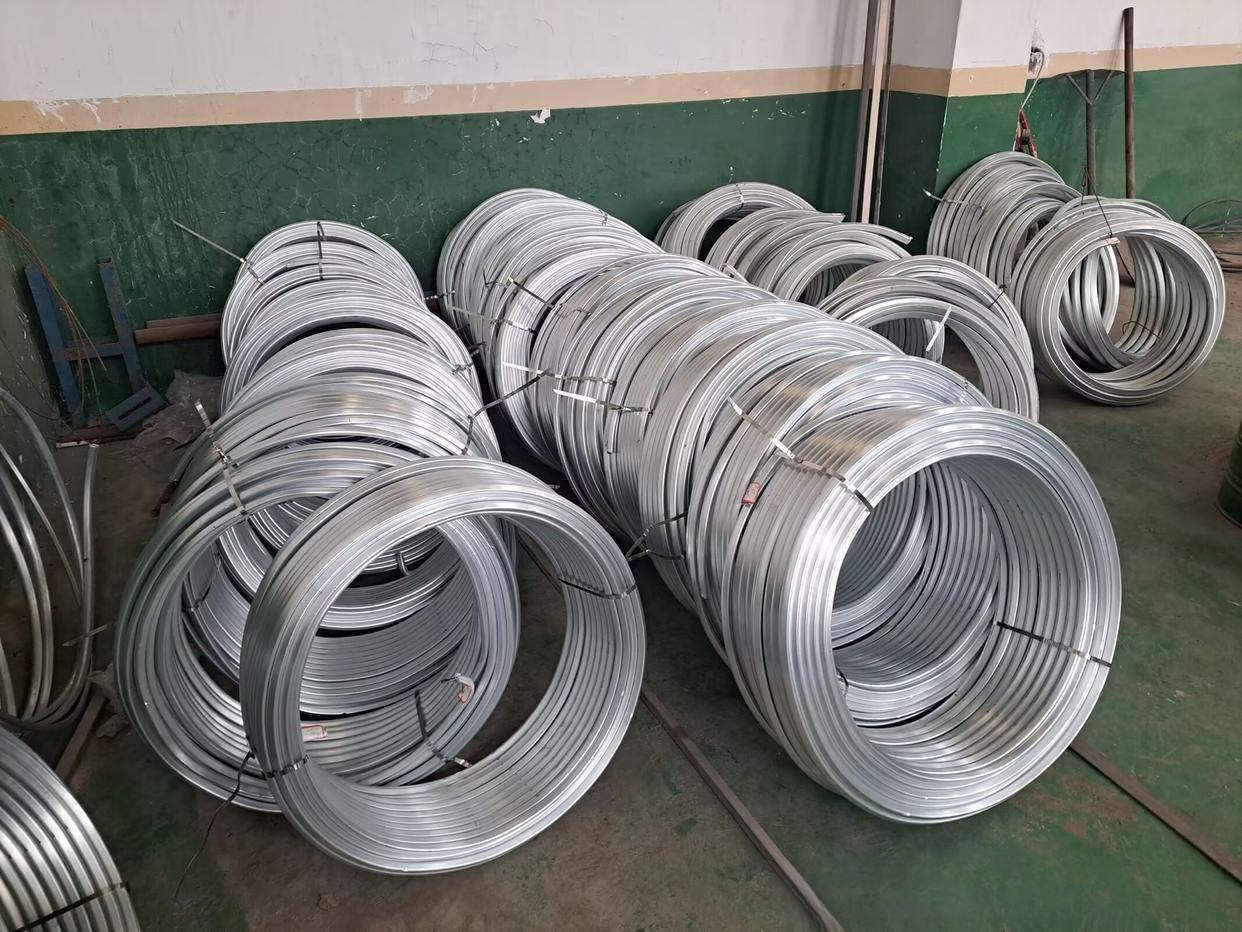
Pipeline Drainage Grounding Zinc Ribbon (Zinc Alloy Ribbon Sacrificial Anode): Working Principle, Standard Sizes and Installation Guide
Quick answer: A pipeline drainage grounding zinc ribbon — also sold as a zinc alloy ribbon sacrificial anode — is a flexible extruded zinc strip built around a galvanised steel core. In a drainage grounding system it holds two jobs at the same time: it acts as a low-impedance grounding electrode that discharges AC stray current, lightning current and fault current to earth from a solid-state decoupler (SSD), drainage pile or insulating joint; and it acts as a sacrificial anode that keeps the pipe, the grounding electrode itself and the pipe inside a casing under continuous cathodic protection. Its open-circuit potential is about −1.05 V to −1.10 V vs Cu/CuSO₄, its theoretical capacity is about 820 Ah/kg (roughly 780 Ah/kg in seawater, lower in soil depending on moisture and resistivity), and the size most often specified for pipeline drainage grounding is ZR-2 (15.88 × 22.22 mm, ≈1.78 kg/m).
That dual role is the reason zinc ribbon is specified instead of a copper conductor on interfered pipelines. Copper is a noble metal: bonded directly to steel it becomes the cathode of a galvanic cell and accelerates pipe corrosion while draining cathodic protection current. Zinc is an active metal, so the same conductor that carries interference current to earth is also delivering protection current to the steel it touches.
What Is a Pipeline Drainage Grounding Zinc Ribbon?
Unlike a conventional block anode, zinc ribbon is a long, thin, flexible strip. It is extruded as a zinc alloy sheath bonded around a central steel wire core, which gives it two properties that matter in the field:
- Mechanical — it can be coiled, bent and laid along a trench line, around a bend, through a casing or across a tank bottom edge, so it can be installed as one continuous electrical path with very few joints.
- Electrochemical — because it is distributed in a line rather than concentrated in a lump, it delivers current evenly along its whole length instead of concentrating protection at a single point.
The internal steel core is not an accessory; it is the current-carrying conductor. This is why installation always involves exposing the core to make the connection, and why the core must never be cut and left unbridged between ribbon sections.
The Two Jobs a Zinc Ribbon Performs in a Drainage Grounding System
Job 1 — Low-impedance grounding electrode
When a pipeline runs parallel to or crosses an electrified railway, a metro line or a high-voltage transmission corridor, AC voltage is induced onto the pipe. That induced voltage raises pipe-to-soil potential, creates a touch-voltage hazard on above-ground fittings, and drives AC corrosion at coating defects. The standard remedy is to give the interference current a controlled, low-impedance path to earth.
The zinc ribbon is that path: buried near and roughly parallel to the pipeline, it lowers the resistance to remote earth and gives stray AC current, lightning surge current and power-line fault current an intentional route into the soil instead of a route through the pipe wall.
Job 2 — Sacrificial anode / continuous cathodic protection
Because zinc is more active than steel, the same ribbon also polarises the steel it is bonded to — the pipe section, the grounding electrode body, and the steel pipe inside a casing — and keeps it cathodic. This eliminates the contradiction that ruins naive grounding designs: adding a grounding electrode normally hurts a cathodically protected pipeline, because a bare metallic electrode drains protection current. A zinc ribbon electrode gives that current back.
How the zinc ribbon and the solid-state decoupler divide the work
| Component | What it does | What it must not do |
|---|---|---|
| Solid-state decoupler (SSD) | Blocks DC (so cathodic protection current stays on the pipe) while passing AC and diverting over-voltage surges | Must not be bypassed by a permanent direct bond to the ribbon |
| Zinc ribbon | Provides the stable, low-impedance earth path and local sacrificial protection | Must not be permanently paralleled straight onto the pipeline |
| Pipe coating + CP system | Keeps the pipe polarised in the areas the ribbon cannot reach | — |
The wiring rule that follows from the table: the zinc ribbon connects to the grounding side of the SSD, not directly to the pipeline. Directly paralleling a bare zinc electrode onto the pipe turns it into a permanent CP current drain and can drop the pipe below the protection criterion at distant coating defects.
Working Principle: What the Numbers Mean
| Property | Value | What it tells you |
|---|---|---|
| Open-circuit potential | ≈ −1.05 to −1.10 V vs Cu/CuSO₄ | Enough driving voltage to protect steel in moist, low-resistivity ground; not enough to cause over-protection |
| Theoretical capacity | ≈ 820 Ah/kg | The charge the zinc couple can deliver per kilogram in theory |
| Practical capacity, seawater | ≈ 780 Ah/kg | The realistic figure to use for design life near the coast, in brackish water or in water-filled casings |
| Practical capacity, soil | Lower, and site-dependent | Moisture content and soil resistivity cut the usable capacity; always design from a site survey, not from the seawater figure |
Zinc's moderate driving voltage is a feature in this application, not a limitation. It is high enough to protect steel in a permanently moist electrolyte, and low enough that over-protection and hydrogen evolution at coating defects are far less likely than with high-potential magnesium — which matters on coated pipe, on aged coatings and on pre-stressed structures.
The practical consequence of the same number is the boundary condition: if the soil is dry and highly resistive, the zinc ribbon's driving voltage is not enough to protect anything. In that case the design has to change — resistance-reducing backfill, a deep-well grounding electrode, or a switch to magnesium anodes or a graphite / high-silicon cast iron grounding electrode. See the comparison table below.
Standard Zinc Ribbon Anode Sizes
Four cross-sections cover almost every project. The weight per metre is the number that sets both the installation handling and the anode's design life; the core diameter is the number that sets how much fault current the ribbon can carry without overheating.
| Size type | Cross-section (mm) | Weight (kg/m) | Steel core dia. (mm) | Standard coil length (m) | Typical use |
|---|---|---|---|---|---|
| ZR-1 (Super) | 25.4 × 31.75 | 3.570 | 4.70 | 30.5 | Heavy structures, grounding grids, tank bottom edges, high fault-current duty |
| ZR-2 (Plus) | 15.88 × 22.22 | 1.785 | 3.43 | 61 | The default for pipeline drainage grounding — best balance of current, life and cost |
| ZR-3 (Standard) | 12.7 × 14.28 | 0.8925 | 3.30 | 152 | Light-duty runs, confined trenches, valve chambers |
| ZR-4 (Small) | 8.73 × 10.32 | 0.372 | 2.92 | 305 | Inside casing pipe, road and river crossings, minimum-clearance spaces |
Custom cross-sections and coil lengths are available where a project specifies them.
Where Zinc Ribbon Fits — and Where It Does Not
Zinc ribbon is the right choice when the site has:
- Low soil resistivity and a high or stable groundwater table, so the electrolyte around the ribbon stays permanently moist.
- A pipeline running parallel to or crossing an electrified railway, metro line or high-voltage transmission line.
- Pipe inside a casing, valve chamber grounding, or storage-tank bottom edge protection — locations where a lumped anode cannot be placed but a flexible ribbon can.
- A drainage grounding system built around solid-state decouplers and drainage piles.
- Terrain that calls for flexible, continuous laying with the minimum practical number of joints.
Zinc ribbon alone will under-perform when:
- Soil resistivity is high and the ground is dry — the ribbon simply cannot push enough current, and the answer is resistance-reducing treatment, deep-well grounding, or a different electrode type (magnesium, graphite, high-silicon cast iron).
Comparison: Zinc Ribbon vs Other Grounding and Anode Options
| Option | What it is | Strength in a drainage grounding role | Limitation | Where it fits best |
|---|---|---|---|---|
| Zinc ribbon (ZR-1 … ZR-4) | Flexible extruded zinc alloy around a steel core | Doubles as grounding electrode and sacrificial anode; continuous current distribution; low driving voltage so no over-protection; flexible, few joints | Needs a moist, low-resistivity electrolyte to do useful work | Interfered pipelines, casing interiors, valve chambers, tank bottom edges |
| Magnesium anode (block or ribbon) | Highest driving voltage of the three sacrificial metals | Protects steel in dry, high-resistivity soil where zinc cannot | Consumes fast in wet, low-resistivity ground; higher over-protection and hydrogen-evolution risk; a poor interference drain because its own consumption inflates | Cathodic protection in resistive soil, not AC interference drainage |
| Copper conductor / copper-bonded rod | Noble metal grounding conductor | Lowest resistance; excellent fault and lightning conduction | Noble metal — directly bonded it forms a galvanic couple and accelerates steel corrosion and drains CP current | Pure electrical grounding, only where DC isolation is correctly engineered |
| Graphite / high-silicon cast iron electrode | Inert, dimensionally stable grounding electrode | Very long life; works in high-resistivity ground and in deep-well configurations | Not a sacrificial anode — it supplies no protection current to the pipe | Where the primary goal is resistance reduction, not protection |
| ICCP (transformer rectifier + MMO or HSCI anodes) | Powered system | High, adjustable output for long pipelines and large structures | Needs power and maintenance; over-protection and interference risk | Long pipelines and large structures, not local point drainage |
Installation: The Details That Decide Whether It Works
- Lay it flat or shallow-buried. Standard practice is a trench below the frost line, at approximately pipe depth or slightly deeper, so the ribbon sits in the same moisture regime as the pipeline.
- Expose the steel core at every connection. Strip back the zinc sheath and make the joint by crimping or welding the core. Every joint then needs multi-layer waterproof sealing — a moisture path into the core is the most common cause of premature failure.
- Keep segments electrically continuous. Where several ribbon lengths are joined, verify continuity. A high-resistance break in the middle turns one effective electrode into two inefficient ones.
- Lay it in permanently moist soil, and backfill with fine soil. Avoid rock, demolition debris and compacted spoil that can crush or abrade the ribbon or create a high-resistance envelope around it.
- Control the grounding resistance to the design value. Project specifications commonly call for ≤ 4 Ω, and lower in strongly interfered corridors. Resistance cannot be assumed after backfill — it has to be measured.
- Connect it to the grounding side of the SSD, not directly to the pipe. This is the single most consequential wiring decision in the whole system: a direct permanent bond drains cathodic protection current away from the pipeline.
- Where AC mitigation is the main purpose, consider low-resistivity select backfill. Specialist AC-mitigation designs surround the ribbon with a select backfill bed to hold the electrolyte resistivity low around the electrode and reduce the coating-stress voltage the pipe sees.
- Document the as-built route. Ribbon is buried and invisible after backfill; test-station locations, joint positions and measured resistance values are what make future surveys possible.
Schematic: the SSD blocks DC to preserve cathodic protection while passing AC; the zinc ribbon provides the earth path and local sacrificial protection.
How to Size a Zinc Ribbon Anode
Anode mass — not length by itself — sets the service life. Four design inputs decide the answer:
- Soil resistivity and moisture profile (Wenner four-pin survey, plus water-table data). This decides whether zinc is the right metal at all, and what current it can realistically deliver.
- AC interference level — induced voltage, longitudinal electric field, fault-current level, and clearance to towers or traction return circuits. This decides the required conductance to earth.
- Target grounding resistance — from the design specification (commonly ≤ 4 Ω, lower in strong interference zones).
- Protection criteria and available space — the structure-to-electrolyte potential criteria the operator has to demonstrate, and the physical room available (casing interiors and crossings force ZR-4).
Design-life calculation
Anode mass        m   = L × w                        (kg)
Available charge  Q   = m × C × u                    (Ah)
Service life      T   = Q ÷ I_mean ÷ 8760            (years)

L = ribbon length (m)         w = weight per metre (kg/m)
C = site current capacity (Ah/kg)   u = utilisation factor
I_mean = mean current output (A)
Worked example (illustrative only — substitute your own site values):
- Size: ZR-2, 100 m → m = 100 × 1.785 = 178.5 kg
- Capacity: C = 700 Ah/kg (moist soil, conservative versus the 780 Ah/kg seawater figure)
- Utilisation: u = 0.85
- Available charge: Q = 178.5 × 700 × 0.85 = ≈ 106,200 Ah
- Mean current output: I_mean = 0.5 A
- Service life: T = 106,200 ÷ 0.5 ÷ 8760 = ≈ 24 years
Two cautions on that arithmetic. First, the same ribbon in high-resistivity soil outputs less current — which lengthens life but may leave the structure under-protected, so life is never the only acceptance criterion. Second, mean current output is a design assumption that should be verified against the measured current after commissioning, then tracked at each survey so the remaining life can be re-projected.
FAQ
What is the difference between a zinc ribbon anode and a zinc block anode? A block anode is a concentrated point source: high current at one location, rapid local voltage gradient, and usually shorter life. A ribbon anode is a distributed line source: it spreads protection evenly along the pipe axis, follows terrain and bends, needs far fewer joints, and can be installed in spaces a block anode cannot enter — inside a casing, for example.
Can a zinc ribbon be connected directly to the pipeline? Not when it is serving as a drainage grounding electrode. Connect it to the grounding side of the solid-state decoupler. A direct permanent bond makes the bare zinc a permanent route for cathodic protection current to leave the pipe, which can push distant coating defects below the protection criterion.
How long does a zinc ribbon anode last? Life is mass-driven: mass × capacity × utilisation ÷ mean current. Use the site soil capacity, not the seawater figure, and re-project remaining life from measured current at each survey.
Why zinc rather than magnesium for AC mitigation and drainage grounding? Magnesium's higher driving voltage is an advantage in dry, resistive soil, but in the moist, low-resistivity ground where drainage electrodes sit it consumes quickly and risks over-protection. Zinc's moderate driving voltage (−1.05 to −1.10 V vs Cu/CuSO₄) is a better fit for a component whose primary job is to conduct current to earth.
What soil conditions rule zinc ribbon out? Dry, high-resistivity soil. The ribbon cannot develop enough current to protect the steel, and the fix is a design change — resistance-reducing backfill, deep-well grounding, or a magnesium or graphite / high-silicon cast iron electrode.
Which size should I default to? ZR-2 (15.88 × 22.22 mm, ≈1.78 kg/m). It is the most widely specified cross-section for pipeline drainage grounding and the best balance of current output, mechanical strength, coil length and cost. Move up to ZR-1 for high fault-current duty, heavy structures or long design life; move down to ZR-3 or ZR-4 where trench or casing clearance is tight.
What installation mistake most often causes premature failure? A poorly sealed connection. If moisture reaches the exposed steel core at a crimped or welded joint, the core corrodes and the electrical path is lost — long before the zinc has been consumed. Multi-layer waterproof sealing at every joint is not optional.
Can a zinc ribbon be used inside a casing pipe? Yes — this is one of its standard applications, and ZR-4 (8.73 × 10.32 mm, ≈0.37 kg/m) exists specifically for it. Inside a casing the ribbon both drains interference current and provides the protected steel pipe with local sacrificial protection that a remote anode cannot supply.
References
- ASTM B418/B418M — Standard Specification for Cast and Wrought Galvanic Zinc Anodes — store.astm.org
- ISO 15589-1:2015 — Petroleum, petrochemical and natural gas industries — Cathodic protection of pipeline systems — Part 1: On-land pipelines — iso.org
- AMPP/NACE SP0169 — Control of External Corrosion on Underground or Submerged Metallic Piping Systems — content.ampp.org
4.Platt Brothers — Plattline zinc ribbon anode for AC mitigation — plattbros.com
About the zinc ribbon anodes described here
Xi'an AUE Technology Co., Ltd. (AUE) manufactures extruded zinc ribbon anodes in the four standard cross-sections above — ZR-1 through ZR-4, offered as Super, Plus, Standard and Small — together with the cathodic protection accessories that go with them: reference electrodes, test stations, junction boxes and transformer rectifiers. Full size data, weight per metre and coil lengths are listed on the Zinc Ribbon Anode product page; the wider zinc anode range covers tank anodes, hull anodes and ribbon, and the magnesium anode range covers the resistive-soil cases described above.
If you are selecting a zinc ribbon for a specific pipeline, railway or HV-corridor crossing, our engineers will size the cross-section, coil length and connection detail against your soil survey and interference study — contact AUE with the project parameters and we will come back with a specification.

