

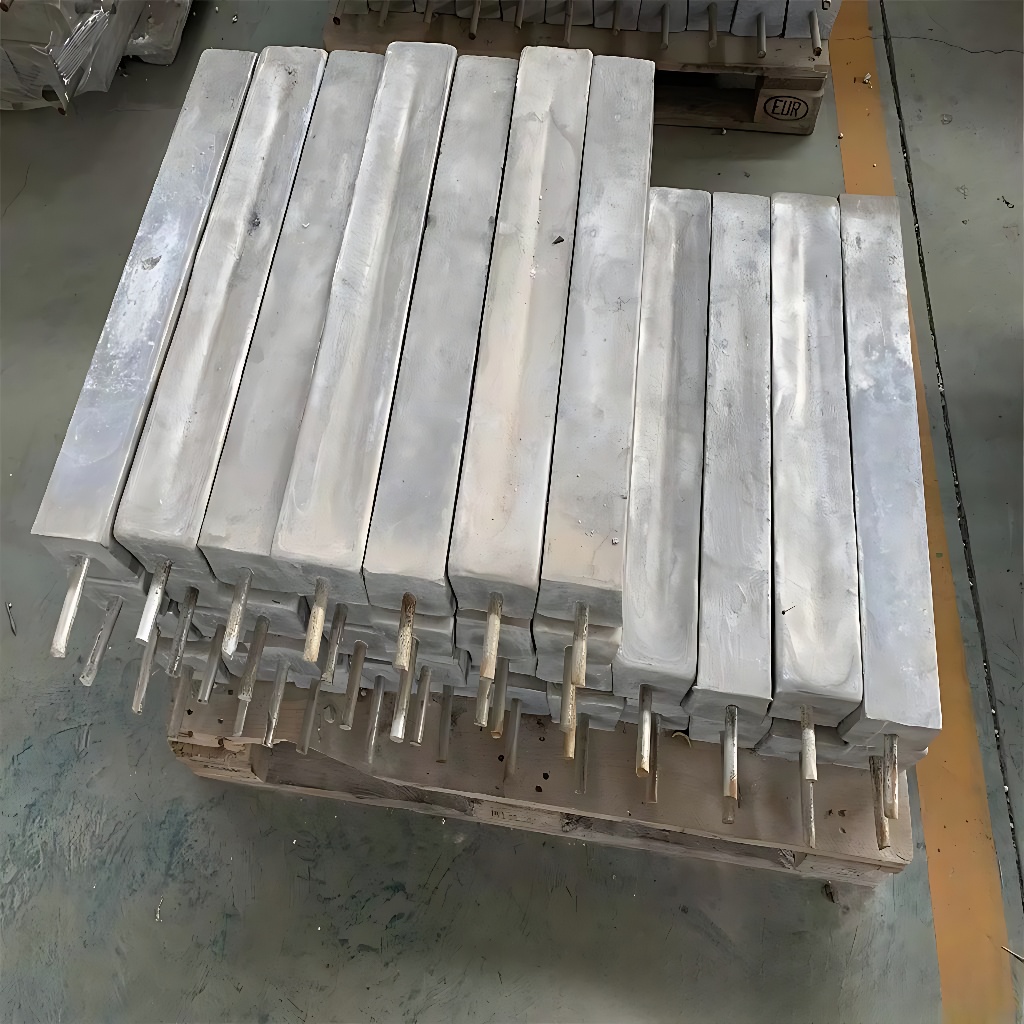
Pre-Packaged Magnesium Sacrificial Anodes: 6 Core Advantages for Buried Steel Structures
Quick answer: A pre-packaged magnesium anode outperforms a bare anode in buried service because the factory controls the three variables that decide field performance — the alloy, the backfill chemistry packed around it, and the cable splice. The unit arrives as a sealed, moisture-retaining bag containing a high-potential magnesium alloy core, a gypsum–bentonite–sodium sulphate backfill and a factory-sealed cable tail. The crew lowers it into the trench and connects it, instead of mixing and tamping backfill on site. The result is a lower and more stable groundbed resistance, steadier current output in medium-to-high resistivity soil, and a service life that matches the design calculation.
Key facts
| Item | Value |
|---|---|
| Alloy | High-potential magnesium alloy, ASTM B843 M1C |
| Open-circuit potential | −1.70 to −1.75 V vs Cu/CuSO₄ |
| Closed-circuit potential | −1.58 to −1.62 V vs Cu/CuSO₄ |
| Current capacity (minimum) | 500 A·h/lb (1,100 A·h/kg) |
| Current efficiency (minimum) | 50% |
| Backfill composition | 75% hydrated gypsum + 20% granular bentonite + 5% sodium sulphate |
| Typical unit | 14.5 kg (32 lb) bare anode; 33 kg packaged; 230 × 680 mm bag |
| Product standards | GB/T 17731-2015; ASTM B843; test method GB/T 24488-2009 |
| Best-fit soil | Resistivity above approximately 2,000 Ω·cm |
| Typical applications | Buried gas and oil pipelines, tank-bottom external surfaces, buried steel structures, casing auxiliary protection |
What makes a magnesium anode "pre-packaged"?
A pre-packaged anode is a complete groundbed in one unit: the cast or extruded magnesium alloy core, a specified chemical backfill, a permeable cotton or synthetic bag holding the backfill around the core, and a factory-terminated insulated cable for connection to the structure. Nothing about the electrochemical design is left to the weather, the soil at the bottom of the trench, or the mixing habits of the installation crew.
Four elements are fixed at the factory:
- Anode core — high-potential magnesium alloy with controlled impurity ceilings (iron, nickel, copper), which is what keeps the anode active instead of self-corroding.
- Backfill — pre-blended to a fixed ratio so that every unit presents the same electrolyte environment to the anode surface.
- Bag — permeable to water, tight enough to keep the backfill in place during handling, lowering and backfilling.
- Cable and splice — factory-sealed, so the connection between anode and cable is not a field joint exposed to groundwater.
That combination is why the six advantages below are structural rather than promotional: each one follows from a design decision made before the unit leaves the plant.
Advantage 1 — One factory-assembled unit replaces a site mixing operation
Backfill is not a filler material. It is the electrolyte that sits between the anode and the structure, and its performance depends on the gypsum-to-bentonite ratio, the moisture content at installation and the absence of contaminants. All three are easy to get wrong in a trench.
Field mixing fails in predictable ways:
- Ratio drift. When backfill is blended by shovel, the gypsum fraction rises or falls between batches, so two anodes on the same pipeline can behave differently.
- Contamination. Native soil, clay lumps or organic matter mixed into the backfill raise resistivity locally and can introduce species that promote passivation.
- Dry pockets. Inadequate wetting leaves dry zones against the anode surface, reducing the effective surface area that is actually delivering current.
A pre-packaged unit removes the operation entirely. The installation sequence becomes: excavate the anode hole, lower the bag, wet it, connect the cable to the structure or test lead, and backfill. There is no mixing, no ratio check and no curing wait before the trench is closed — which is the practical source of the schedule and labour savings on pipeline spreads and tank-farm retrofits.
What to verify on site: bag integrity before lowering, packaged weight against the delivery note, cable continuity, and insulation resistance of the cable tail before the excavation is backfilled. Those four checks replace the quality control that site mixing never had.
Advantage 2 — Optimised backfill chemistry keeps groundbed resistance low and stable
Magnesium is the most active of the three common sacrificial metals, and that activity has a cost: in contact with certain soils, corrosion products can accumulate on the anode face and push the surface toward passivation. The anode then keeps losing mass while delivering progressively less current — the failure mode that matters most, because it is invisible until a potential survey shows under-protection.
The gypsum–bentonite–sodium sulphate system addresses each part of that problem:
| Component | Share | Function in the groundbed |
|---|---|---|
| Hydrated gypsum (CaSO₄·2H₂O) | 75% | Supplies a soluble sulphate environment that keeps the magnesium surface electrochemically active and resists passivation |
| Granular bentonite | 20% | Retains moisture, maintains continuous contact between anode and backfill, and limits ingress of native soil |
| Sodium sulphate (Na₂SO₄) | 5% | Raises the conductivity of the electrolyte immediately around the anode |
Two consequences follow. First, the resistance to earth is set by a designed material rather than by whatever the trench happens to contain, so the current output of a given anode becomes predictable at the design stage. Second, because bentonite holds water, the resistance stays comparatively stable through seasonal drying — in sandy or loess soils, an unprotected bare anode can lose a large share of its output in a dry season while a pre-packaged unit keeps working.
Compared with a bare magnesium anode in the same soil, a pre-packaged unit delivers a steadier current and converts a higher proportion of its mass into protective current. That is the difference between anode utilisation efficiency on paper and on site.
Advantage 3 — High driving potential covers medium and high resistivity soil
Cathodic protection of buried steel is governed by a simple relationship: the current an anode can push is the difference between its potential and the protected potential of the structure, divided by the resistance of the circuit — and in dry soil, that resistance is dominated by the electrolyte.
The numbers make the case for magnesium. With an open-circuit potential of −1.70 to −1.75 V versus Cu/CuSO₄ and a protection criterion of −0.85 V versus Cu/CuSO₄ (the classical criterion in NACE SP0169), the available driving voltage is roughly 0.85 to 0.90 V. A zinc anode at about −1.10 V leaves only about 0.25 V of headroom — enough in wet, low-resistivity clay, not enough in dry sand, gravel or loess.
That is why the conventional selection rule is stated in terms of soil resistivity: zinc anodes are used where resistivity is below about 2,000 Ω·cm, while magnesium is specified above that threshold. In inland buried pipelines, tank bottoms and buried steel structures sitting in sandy or loess soils, magnesium is often the only sacrificial option that can polarise the structure at all without going to an impressed current system.
Advantage 4 — No power supply, no rectifier, minimal operating workload
A sacrificial anode system has no transformer rectifier, no AC feed, no control cabinet and no settings to drift. Once the unit is buried and connected, protection begins immediately and continues unattended for the life of the anode. For branch lines, isolated pipeline sections, abandoned-but-monitored segments and sites where no power is available, that is decisive: an impressed current system cannot be justified, and a magnesium groundbed can.
The second operational advantage is the absence of wide-area stray current interference. A sacrificial groundbed operates at low current over a short distance, so the interference footprint on neighbouring structures is small — a real consideration in congested pipeline corridors and tank farms.
Routine work reduces to monitoring:
- Potential measurements at test posts, read against a Cu/CuSO₄ reference electrode and assessed against the −0.85 V criterion or 100 mV of polarisation decay.
- Period checks of cable insulation resistance and connection condition at the test lead.
- Replacement planning driven by measured current output, not by calendar age.
There is a boundary worth stating plainly: sacrificial anodes deliver limited current per unit. On large bare structures or badly coated pipe, the number of anodes required can become uneconomic, and an impressed current system with MMO anodes is the correct answer.
Advantage 5 — Standardised product simplifies specification, inspection and procurement
A pre-packaged magnesium anode is a catalogue item defined by a standard, not a bespoke assembly. In China, GB/T 17731-2015 is the governing standard for magnesium alloy sacrificial anodes, replacing the 2009 edition, and it fixes alloy grades, chemical composition and electrochemical performance requirements. Internationally, ASTM B843 covers the cast and extruded magnesium alloys used in cathodic protection, including the high-potential M1C grade, while ASTM G97 defines the laboratory evaluation of potential and current capacity for underground service. GB/T 24488-2009 sets out the electrochemical performance test method using a saturated calcium sulphate and magnesium hydroxide electrolyte — the laboratory analogue of a gypsum-bentonite groundbed.
For a buyer, standardisation produces three practical benefits:
- Repeatable selection. Mature sizes — 8 kg, 14 kg and 22 kg bare-anode weights, alongside imperial units such as the 32 lb (14.5 kg) pre-packaged unit — mean a bill of materials can be reissued for the next phase of a project without redesign.
- Verifiable incoming inspection. Weight, dimensions, alloy certificate, open-circuit and closed-circuit potential and current capacity can all be checked against a published requirement, which turns acceptance into a measurement rather than an argument.
- Controlled cable termination. Units are supplied with XLPE-insulated cathodic protection cable and a factory-sealed splice. Water ingress at the anode-to-cable joint is one of the commonest causes of an anode that is physically intact but electrically dead, and it is exactly the defect that factory sealing eliminates.
Advantage 6 — Wide application range and flexible point placement
Because each unit is independent, pre-packaged magnesium anodes can be distributed to match the actual corrosion risk instead of following a rigid grid. Typical uses include:
- Buried steel gas and oil transmission and distribution pipelines.
- External surfaces of tank bottoms, where anodes are placed in a ring or grid beneath the base.
- Buried structural steel — piles, anchors, supports and grounding conductors.
- Auxiliary protection inside casings and at road or river crossings.
- Rehabilitation of older pipelines, where additional anodes are added at coating defects and known hot spots rather than along the whole route.
The same flexibility supports staged construction. Anodes can be added later at locations identified by close-interval potential surveys, which is rarely possible with a centralised impressed current groundbed.
For non-standard geometry — condensers, heat exchangers, bracelet-style attachments or bespoke castings — custom cast magnesium anodes remain available, and the magnesium anode range covers both extruded and cast formats.
Pre-packaged vs bare magnesium anode: what actually changes
| Dimension | Bare magnesium anode | Pre-packaged magnesium anode |
|---|---|---|
| Backfill quality | Mixed on site; ratio and moisture vary by crew | Factory-blended to a fixed ratio in every unit |
| Groundbed resistance | Set by native soil and installation practice | Set by designed backfill; predictable and repeatable |
| Anode surface condition | Risk of passivation from soil contact and corrosion products | Backfill maintains an active surface and drains corrosion products |
| Seasonal stability | Output falls as soil dries | Bentonite retains moisture; output more stable |
| Installation | Mix, place, tamp, cure | Lower, wet, connect, backfill |
| Cable joint | Field splice exposed to groundwater | Factory-sealed splice and XLPE insulation |
| Quality control | Depends on supervision | Verifiable by weight, dimensions, certificate and electrical test |
| Cost | Lower material cost per kg | Higher unit cost, lower installed cost and fewer callbacks |
Magnesium vs zinc vs aluminium: where pre-packaged magnesium fits
| Anode metal | Open-circuit potential | Where it is the right choice | Where it fails |
|---|---|---|---|
| High-potential magnesium | −1.70 to −1.75 V vs Cu/CuSO₄ | Soil above roughly 2,000 Ω·cm; buried pipelines, tank bottoms, buried steel | Seawater and brine — consumed too quickly; large bare structures needing high current |
| Zinc | Approximately −1.10 V vs Cu/CuSO₄ | Low-resistivity soil and brackish water | High-resistivity soil — insufficient driving voltage, passivation, chronic under-protection |
| Aluminium (Al-Zn-In) | Approximately −1.05 to −1.10 V vs Ag/AgCl | Seawater, saline mud, marine structures | Dry soil — under-activation and unreliable output |
The selection rule is therefore not commercial but electrochemical: driving voltage determines what an anode can protect, and current capacity determines how long it protects.
How many units, and how long will they last?
Two calculations decide the groundbed, and both are worth running before a purchase order is raised.
Service life. Usable charge is the anode mass multiplied by current capacity and current efficiency; life is that charge divided by the average current output:
Life (years) = (mass × capacity × efficiency) ÷ (average current × 8,760)For a 14.5 kg unit at 1,100 A·h/kg and 50% efficiency, usable charge is about 7,975 A·h. At an average output of 50 mA, that is roughly 159,000 hours — about 18 years. At 100 mA, the same unit lasts about 9 years. Mass does not change; current demand does.
Current output per anode. Output follows the driving voltage and the circuit resistance, and for a vertical anode the groundbed resistance is estimated with Dwight's equation:
R = (ρ ÷ 2πL) × (ln(4L ÷ d) − 1)where ρ is soil resistivity (Ω·cm), L the anode length and d its diameter (both in cm). Because resistivity sits in the numerator, doubling soil resistivity halves the current a given anode can deliver — which is precisely why the backfill in a pre-packaged unit, and its moisture retention, matters more than the alloy alone in dry ground.
Sizing the number of anodes then becomes a division: total protective current required, divided by the output per unit, with a margin for coating deterioration over the design life.
When pre-packaged magnesium is the wrong specification
Credibility in cathodic protection comes from knowing the boundaries:
- Seawater, brine and saline mud. Magnesium's high activity causes rapid consumption; aluminium anodes are the economic choice.
- Low-resistivity, wet clay below about 2,000 Ω·cm. Zinc delivers adequate protection at lower cost and with less risk of over-protection and coating disbondment.
- High current demand on large bare structures. The number of sacrificial units required becomes impractical; an impressed current system with MMO anodes is the correct route.
- Very hot, dry service. Backfill can desiccate, so the design must account for moisture availability rather than assuming the packaged unit solves every environment.
If the environment is uncertain, the sequence is fixed: measure soil resistivity along the route, calculate the required current from coating condition and surface area, then match the metal to the electrolyte. A worked comparison of metals and reference electrodes is set out in our guide to choosing sacrificial anodes and reference electrodes, and the underlying mechanism is covered in what sacrificial anode cathodic protection is and how it protects industrial infrastructure.
FAQ: pre-packaged magnesium anodes
What is a pre-packaged magnesium anode? It is a factory-assembled groundbed unit: a high-potential magnesium alloy core surrounded by a gypsum–bentonite–sodium sulphate backfill, enclosed in a permeable bag, with an insulated cable tail sealed to the anode at the plant. It is installed as a single item, with no site mixing of backfill.
Why is backfill necessary at all? Backfill performs three functions: it keeps the anode surface electrochemically active and resists passivation, it retains moisture so the groundbed resistance stays low and stable, and it limits contact between the anode and aggressive native soil. A bare anode in dry, resistive soil can be largely inactive despite being correctly sized.
How is a pre-packaged magnesium anode installed? Excavate the anode hole, lower the unit in the designed orientation (vertical below the pipe or horizontal alongside it), wet the bag thoroughly, connect the cable to the structure by thermite weld or brazed connection and to the test lead, then backfill in compacted layers. Cable continuity and insulation resistance should be checked before the excavation is closed.
Should I choose 8 kg, 14 kg or 22 kg units? Size follows the required current and design life, not convenience. Larger units last longer at the same current output, which reduces the number of excavations over the asset's life; smaller units allow finer distribution where current demand is low or space is restricted. Run the life calculation with the actual average current before fixing the size.
How long does a pre-packaged magnesium anode last? Life is usable charge divided by average current. A 14.5 kg high-potential unit at 1,100 A·h/kg and 50% efficiency holds roughly 7,975 A·h of usable charge — about 18 years at 50 mA, or about 9 years at 100 mA. Current efficiency, not nominal weight, is what separates two anodes of identical mass.
Can pre-packaged magnesium anodes be used in seawater? They function, but they are the wrong economic choice. In low-resistivity electrolytes magnesium is consumed rapidly; aluminium or zinc anodes are normally specified for marine and brackish service, and magnesium is reserved for soil.
What documentation should accompany a delivery? An alloy certificate with heat-level chemical composition, electrochemical performance data (open-circuit potential, closed-circuit potential, current capacity, current efficiency), dimensional and weight records, and cable test data. Where the project is specified to GB/T 17731-2015 or ASTM B843, the certificate should reference that standard explicitly.
How is protection verified after installation? Measure the structure-to-soil potential at test posts against a Cu/CuSO₄ reference electrode and compare with the −0.85 V criterion or 100 mV of polarisation decay under NACE SP0169. A first reading shortly after installation, followed by periodic readings, shows whether the groundbed is delivering design current before under-protection causes damage.
Conclusion
The advantages of a pre-packaged magnesium anode are not marketing claims about convenience. They are the consequences of moving three quality-critical operations — alloy control, backfill blending and cable sealing — from a trench into a factory, and then combining them with the highest driving potential available among sacrificial metals. For buried steel in medium and high resistivity soil, that combination produces the one outcome asset owners actually buy: predictable protection current for a predictable number of years.
Xi'an AUE Technology Co., Ltd. (anodeae.com) manufactures pre-packaged magnesium anodes and cast and extruded magnesium anodes to GB/T 17731-2015 and ASTM B843, with documented electrochemical test data and a quality system covering incoming material, casting, backfill blending and cable termination. For projects where soil conditions sit near the magnesium/zinc boundary, send us your resistivity and coating data and our engineers will run the selection and sizing calculation with you.
References and standards
- GB/T 17731-2015, Magnesium alloy sacrificial anodes — issued 2015-09-11, effective 2016-04-01, superseding GB/T 17731-2009. Standard record
- GB/T 24488-2009, Test method for electrochemical performance of magnesium alloy sacrificial anodes — saturated calcium sulphate / magnesium hydroxide electrolyte.
- ASTM B843, Standard Specification for Magnesium Alloy Anodes for Cathodic Protection — ASTM B843-18e1
- ASTM G97, Standard Test Method for Laboratory Evaluation of Magnesium Sacrificial Anode Test Specimens for Underground Applications — ASTM G97-18(2022)
- NACE SP0169, Control of External Corrosion on Underground or Submerged Metallic Piping Systems — −0.85 V and 100 mV polarisation criteria. Overview
- Soil resistivity and anode metal selection: zinc in soils below about 2,000 Ω·cm, magnesium above. WASET study on soil resistivity and sacrificial anode performance

