

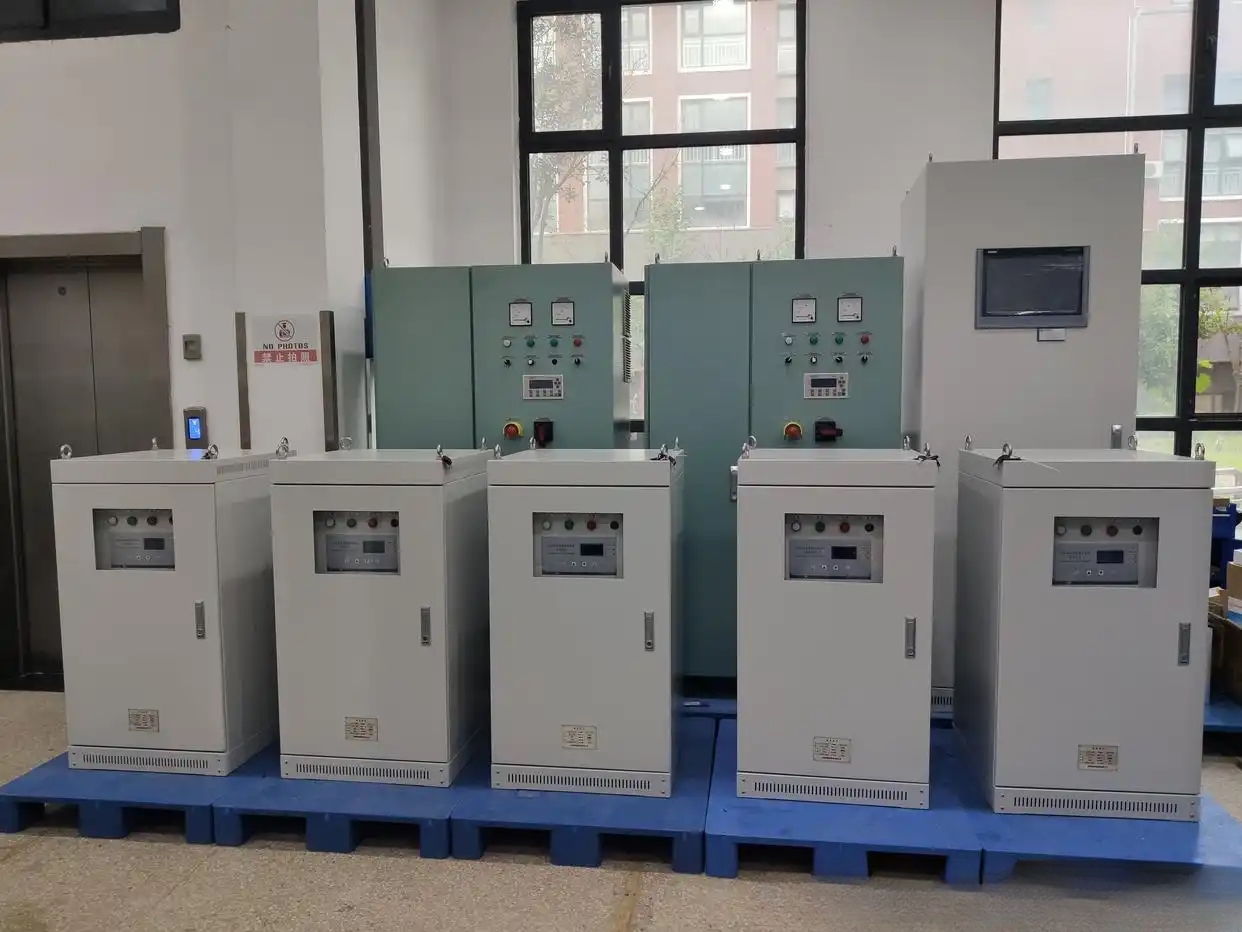
The Basic Working Principle of a Potentiostat
A potentiostat relies on a three-electrode closed-loop negative feedback control scheme, which differentiates it from an open-loop ordinary DC rectifier power supply. It uses the reference electrode as a stable potential benchmark, continuously measuring the structure-to-soil potential of protected steel and comparing the reading against a preset protective potential setpoint.
The reference electrode continuously captures the pipe-to-soil potential of buried pipelines or steel structures and sends the signal to the control unit of the main unit.
The controller compares the measured potential with the set potential and calculates the deviation.
Output power is automatically adjusted according to the deviation direction:
Measured potential is more positive (under-protection): Increase output current to strengthen cathodic polarization and shift the potential negatively.
Measured potential is too negative (over-protection, with hydrogen evolution and hydrogen embrittlement risks): Reduce output current, weaken polarization and let potential drift back positively.
This high-speed adjustment cycle runs continuously to offset external disturbances, including soil moisture variation, coating defects, anode aging and stray current interference. It stabilizes the structure potential within the target protection window.
Engineering note: Distinction between on-potential and instant-off potential. The potentiostat controls the closed-loop potential under powered conditions. To verify real polarization performance and eliminate IR drop, engineers adopt the instant-off method with polarization coupons or cathodic protection test station and check compliance with ISO and GB/T 21448 cathodic protection standards.
Three standard operation modes are available for field ICCP deployment:
Potentiostatic mode (Primary Mode): Potential is the control target; current varies automatically with load. This is the preferred mode for impressed current cathodic protection.
Galvanostatic mode: Fixed DC output current without potential closed-loop regulation. Used as emergency backup when the reference electrode is damaged or signal cables break.
Constant voltage mode: Fixed voltage applied between auxiliary anode and protected structure. Potential remains uncontrolled, mainly used for loop troubleshooting and commissioning tests.
Full System Composition of Impressed Current Cathodic Protection
A potentiostat never operates independently. A complete impressed current cathodic protection system consists of five coordinated modules.
1. Potentiostat Main Unit (The Control Brain)
Two mainstream types are widely used in the industry: SCR type and high-frequency switching type.
SCR potentiostat: High output power and strong surge tolerance, suitable for heavy-load long-distance pipeline trunk lines. Limitations include higher ripple current and moderate response speed.
High-frequency switching potentiostat: Compact footprint, high energy efficiency, low ripple and high control accuracy with rich communication interfaces. It has become the mainstream selection for digitalized CP projects.
The main unit integrates rectifier modules, control boards, sampling circuits, protection circuits and communication modules. Built-in protections cover overcurrent, short circuit, overheating and lightning surge. Critical projects adopt dual-unit hot standby configuration with automatic switchover to avoid protection interruption.
2. Reference Electrode (Potential Benchmark Unit)
Common grades include copper sulfate reference electrodes (CSE) and silver/silver chloride (Ag/AgCl) reference electrodes for seawater or high-moisture buried environments. The reference electrode draws negligible current; its sole function is delivering a stable reference potential for the controller. Potential drift or failure of the reference electrode will invalidate the whole closed-loop regulation.
3. Protected Structure (Working Electrode, WE)
Buried steel pipelines, storage tank bottoms, steel sluice gates, steel wharf piles and other steel assets serve as the protected cathode inside the electrochemical circuit.
4. Auxiliary Anode Groundbed (Counter Electrode, CE)
DC current flows out from the positive terminal of the potentiostat, passes through the auxiliary anode, travels through soil or seawater electrolyte to the protected steel structure, then returns to the negative terminal of the potentiostat to close the circuit.
Available anode materials: high silicon cast iron anodes, MMO titanium anode (mesh, rod, ribbon type) and graphite anodes. Material selection depends on soil resistivity and service medium. Groundbed configurations include shallow anode groundbeds and deep well anode groundbeds.
5. Monitoring & Auxiliary Accessories
Test stations (conventional / smart test stations): Gather signal leads and collect on / off potential, branch current and AC interference voltage. Smart test stations support remote data upload and alarm triggers when readings exceed thresholds.
Cables: Anode power cables, cathode bonding cables and shielded reference signal cables. Shielding for reference wiring is mandatory to suppress power-frequency interference.
Insulating joints / insulating flanges: Electrically isolate protected pipe segments from unprotected metal structures to prevent leakage of protective current.
Drainage devices: Solid-state decouplers and current drainers. Deployed for pipelines running parallel to high-voltage lines or subway lines, to dissipate AC stray interference while retaining DC protective current.

