

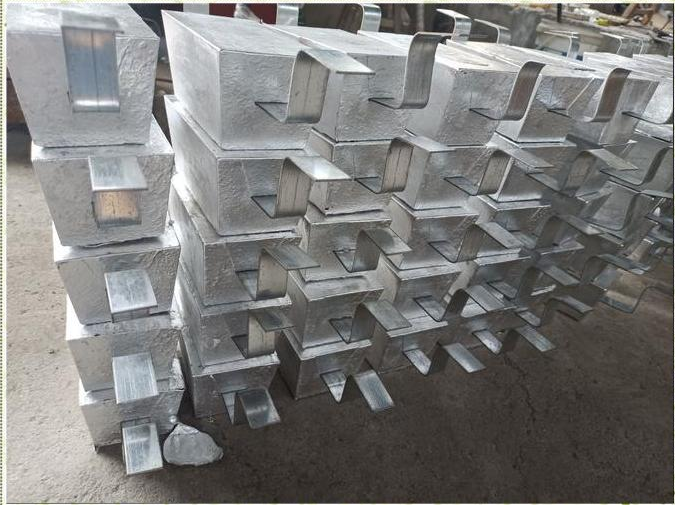
Why Aluminium Anodes Perform Better in Seawater: A Comprehensive Analysis
Quick answer: Aluminium anodes perform better in seawater because they combine the highest electrochemical capacity of the three common sacrificial metals (2,980 A·h/kg theoretical, roughly 2,500–2,600 A·h/kg delivered) with a stable driving potential of about −1.05 to −1.10 V versus Ag/AgCl, and a density one-third that of zinc. Seawater chloride actively destroys the passive oxide film that would otherwise make aluminium inert, and modern Al-Zn-In alloys — plus newer multi-element grades — keep the surface active for the whole design life. The result is fewer anodes, lower structural load and longer replacement intervals than zinc, without the overprotection risk of magnesium.
Key takeaways
- Aluminium's theoretical capacity of 2,980 A·h/kg is about 3.6× zinc (820 A·h/kg) and 1.35× magnesium (2,200 A·h/kg).
- Pure aluminium passivates; zinc, indium, gallium and magnesium additions re-activate the surface through an activation–redeposition mechanism.
- Chlorides help, not hinder aluminium anodes — they break down the Al₂O₃ layer and sustain active dissolution.
- At 2.70 g/cm³ versus zinc's 7.14 g/cm³, aluminium cuts anode weight by roughly 62% for the same volume — decisive for deepwater installation.
- A 2025 eight-element alloy study reported over 92% current efficiency under simulated deep-sea conditions (high pressure, low temperature, low dissolved oxygen).
- Aluminium is the wrong choice in freshwater and high-resistivity media; there, magnesium remains correct.
Why is seawater so aggressive to steel structures?
Seawater is an unusually efficient electrolyte. Its dissolved salts — chloride dominant at roughly 19 g/kg in normal salinity — carry current readily, so any potential difference between two metals on a submerged structure is converted into a corrosion current almost without resistance.
That produces three distinct damage mechanisms on offshore assets:
- Galvanic corrosion. When dissimilar metals are coupled in seawater, a natural cell forms. The more active metal becomes the anode and dissolves; the more noble metal becomes the cathode and is protected. A stainless steel fitting bolted to a carbon steel jacket is a classic example, and the attack concentrates at the joint.
- Concentration-cell and crevice attack. Under marine growth, weld spatter, gasket faces and coating holidays, oxygen availability differs from the surrounding surface, and the starved area becomes anodic.
- Mechanical acceleration. High-strength steels used in deepwater equipment — risers, subsea trees, mooring hardware, hull structure — are sensitive to hydrogen uptake and to stress-corrosion cracking once corrosion has initiated. Wall loss alone understates the risk; loss of fracture toughness is the failure mode that matters. Titanium components behave differently: titanium is highly resistant in seawater, but it is strongly cathodic to steel, so any steel it is coupled to becomes the anode and corrodes faster.
The deep sea adds pressure, low temperature and variable dissolved oxygen to that picture. Lower temperature slows reaction kinetics and lowers diffusion rates; lower oxygen limits the cathodic reaction that sustains corrosion. The net effect is not "no corrosion" — it is corrosion that is harder to inspect, harder to predict from shallow-water data, and enormously expensive to remediate at 1,000 m.
Sacrificial anode cathodic protection turns this mechanism into an engineering tool: instead of fighting the galvanic cell, it deliberately creates one, with an anode designed to be consumed so the structure is not.
Why do aluminium anodes outperform zinc and magnesium in seawater?
Four properties separate aluminium from the alternatives, and each one translates directly into project cost.
1. The highest current capacity per kilogram
Current capacity — the charge a kilogram of anode metal can deliver before it is spent — sets how much anode mass a design needs for a given current demand and design life.
| Anode metal | Theoretical capacity | Typical delivered capacity | Practical efficiency |
|---|---|---|---|
| Aluminium (Al-Zn-In) | 2,980 A·h/kg | ≈ 2,500–2,600 A·h/kg | ≈ 85–92% |
| Zinc | 820 A·h/kg | ≈ 780 A·h/kg | ≈ 95% |
| Magnesium (standard grade) | 2,200 A·h/kg | ≈ 1,100–1,230 A·h/kg | ≈ 50–56% |
The distinction between theoretical and delivered capacity matters. Theoretical capacity assumes every atom of the metal is oxidised at full valence. Real anodes lose efficiency to self-corrosion, to intermetallic phases that do not dissolve usefully, and to parasitic reactions. Magnesium's low efficiency is the most dramatic: its 2,200 A·h/kg headline figure is nearly halved in service, which is why magnesium anode mass calculations that use the theoretical number under-deliver protection.
For aluminium, the delivered figure is what drives the commercial argument. At 2,500 A·h/kg, one tonne of aluminium anode does the work of roughly 3.2 tonnes of zinc. On a jacket or a hull where anode mass is measured in hundreds of tonnes, that difference is not a line item — it is a structural load, a crane lift, a fabrication schedule and a fuel bill.
2. Alloying overcomes aluminium's passivity
Pure aluminium is a poor anode. In oxygenated water it immediately forms a coherent Al₂O₃ film a few nanometres thick, which is chemically stable, electrically insulating and self-repairing. That film is precisely why aluminium is a good structural material and a bad electrode.
Commercial aluminium anodes defeat it by alloying. Zinc at several percent and indium at hundredths of a percent — with gallium, magnesium, tin or cadmium in some grades — alter both the film's chemistry and its defect structure. Indium and gallium are the key activators: they adsorb at the oxide–metal interface and, through what the literature describes as an activation–redeposition mechanism, they dissolve preferentially and redeposit as metallic islands on the surface. Those islands are not passive, so the anodic reaction continues through them, and the surrounding oxide layer is progressively undermined and re-activated rather than allowed to thicken.
The engineering consequence is a stable closed-circuit potential over months and years, not the drifting potential of a passivating electrode. That stability is what makes protection calculable: a design that assumes −1.05 V is only valid if the anode actually holds −1.05 V.
3. Chloride-rich water is an advantage, not a limitation
In freshwater, chloride is too scarce to break down the passive film, and aluminium anodes under-perform badly. In seawater the situation inverts. Chloride ions are small, mobile and aggressively adsorbed; they penetrate oxide films, form soluble chloro-complexes with aluminium and prevent the film from re-forming. High chloride concentration therefore supports the anode's chemistry instead of fighting it.
This is the fundamental reason the material selection logic is reversed between the two environments: aluminium for seawater and saline mud, magnesium for freshwater and soil. Using magnesium in seawater does not fail by under-protection — it fails by over-protection, discussed below.
Zinc occupies the middle ground. It works in seawater and brackish water and is predictably behaved, but it is heavy and its capacity per kilogram is roughly a third of aluminium's.
4. Density one-third that of zinc
Aluminium's density of 2.70 g/cm³ against zinc's 7.14 g/cm³ means an aluminium anode of the same volume weighs about 38% as much. For a fixed required mass, aluminium occupies more volume — but on marine structures, volume is usually available and weight is not.
The benefit compounds in deep water. Every kilogram of anode on a subsea template or a deepwater riser adds buoyancy requirement, handling load and installation cost. On a floating structure it also adds to the displacement the hull must carry for the whole service life. Reducing anode mass by two-thirds is one of the few changes in a marine project that improves both capex and opex simultaneously.
What does a modern eight-element aluminium anode add?
The Al-Zn-In family is the established baseline for seawater. Recent materials research has looked beyond it, adding calcium, magnesium, manganese, titanium and gallium to the melt to improve performance where conventional alloys degrade.
A 2025 study published in Surface Technology examined an eight-element aluminium alloy anode and reported three findings that matter to designers.
Grain refinement. Multi-element alloying refines the grain structure of the casting, which improves both mechanical integrity and electrochemical uniformity. A finer, more homogeneous microstructure dissolves more evenly, so the anode keeps its shape and its output instead of developing deep localised pits that waste metal. The study also found a limit: excessive magnesium additions introduce casting defects, which is why composition windows have to be tight rather than "more is better".
Deep-sea current efficiency above 92%. Under simulated deep-sea conditions — high pressure, low temperature, limited dissolved oxygen — a correctly formulated eight-element anode sustained current efficiency above 92%. That is a meaningful number, because conventional alloys typically lose efficiency as temperature falls and oxygen becomes scarce.
Micro-galvanic activation. Micron-scale precipitates of calcium, indium and titanium form a uniformly distributed network of micro-galvanic sites on the anode surface. These sites raise surface activity, which keeps the anode dissolving, while the same distribution limits self-corrosion. That balance — more activation without more parasitic wastage — is the central problem in anode metallurgy, and it is what separates a 92% alloy from an 80% one.
The study's reported optimal ranges for the key additions:
| Element | Reported optimum (wt%) | Function |
|---|---|---|
| Mg | 0.9–1.0 | Grain refinement, surface activation; excess introduces casting defects |
| Ti | 0.018–0.020 | Grain refinement, micro-galvanic precipitate formation |
| Ca | 0.05–0.06 | Micro-galvanic activation, self-corrosion control |
| Mn | 0.09–0.10 | Microstructural homogenisation, impurity control |
These are narrow windows, measured in hundredths of a percent for titanium and calcium. They cannot be hit by visual inspection or by trusting an ingot certificate alone. They require spectrographic analysis of the finished casting, batch by batch — which is the practical reason alloy development and quality control have to be treated as one discipline rather than two.
Aluminium vs zinc vs magnesium: which anode for which water?
| Anode type | Best environment | Key advantage | Limitation |
|---|---|---|---|
| Al-Zn-In aluminium | Full-strength seawater, saline mud, brine service | Highest capacity per kg, stable potential, strong passivation resistance, long service life | Poor performance in freshwater and high-resistivity media |
| Multi-element aluminium (Al-Zn-In + Ga, Mg, Ca, Mn, Ti) | Deep sea, cold seawater, long design lives | >92% current efficiency in simulated deep-sea conditions; refined, uniform dissolution | Narrow composition windows; demands tighter process control |
| Zinc | Brackish water, estuarine and salinity-variable conditions, saline mud | Reliable, well-understood, low driving potential so overprotection risk is minimal | About 2.6× the density of aluminium for the same volume; roughly one-third the capacity per kg |
| Magnesium | Freshwater, soil, high-resistivity electrolyte | Very high driving potential (≈ −1.5 V), light, effective where conductivity is low | Unsuitable for seawater: overprotects, damages coatings, and is consumed far too quickly |
The selection rule that prevents most marine anode failures is simple: match the alloy to the electrolyte, then let capacity set the mass. Aluminium wins in seawater because it is the only one of the three that is simultaneously high-capacity, dimensionally light and chemically suited to a chloride environment.
Al-Zn-In aluminium has been the reference standard for seawater service for decades. Its combination of current capacity, driving potential and service life is the balance point that offshore specifications, classification society rules and design codes are written around.
When should you not use aluminium anodes?
Aluminium is the right answer in seawater and the wrong answer in fresh water, and the mechanism is the same in both cases: passivity. Where chloride concentration is too low to destabilise the Al₂O₃ film, the anode polarises, output collapses, and the structure sits under-protected while the anode still looks physically intact. That failure mode is worse than plain consumption, because it is invisible.
Practical boundaries:
- Freshwater tanks, boilers and water heaters → magnesium, or zinc where conductivity allows.
- High-resistivity soil and backfill → magnesium; aluminium is not a soil anode.
- Variable-salinity estuaries → zinc is the conservative choice where salinity swings below roughly half seawater strength; verify with measured conductivity rather than assuming.
- Aluminium-hulled vessels → zinc or specialist aluminium alloys formulated for aluminium hulls; standard Al-Zn-In anodes coupled to an aluminium hull create their own galvanic problem.
- Any environment where coating damage must be avoided → avoid magnesium in seawater. Its high driving potential generates hydrogen at the cathode, which lifts paint and can embrittle high-strength steels.
How do you specify an aluminium anode system for a seawater project?
A defensible specification rests on five measured inputs, not on rules of thumb:
- Electrolyte data. Salinity or conductivity by depth, temperature range, dissolved oxygen and fouling regime. Deep-sea designs that reuse surface current densities are systematically over- or under-sized.
- Coating condition and bare area. Design current density is applied to the surface the coating does not cover. Coating breakdown over the design life, not day-one condition, drives the calculation.
- Design life and current demand. Current demand × design life ÷ delivered capacity = required anode mass. Use delivered capacity, not the theoretical figure.
- Anode geometry and distribution. Current throws a limited distance in seawater. Anode spacing, standoff and shield placement determine whether the calculated current actually reaches the steel.
- Monitoring. Reference electrodes, test stations and a survey schedule, so protection is demonstrated against the −850 mV versus Ag/AgCl or 100 mV polarisation criteria rather than assumed.
The governing documents for offshore work are DNV-RP-B401 for cathodic protection design, ISO 15589-2 for offshore pipeline systems, and NACE/AMPP SP0387 for the metallurgical and inspection requirements of cast sacrificial anodes. All three treat anode chemistry as a specification item, not a purchasing detail — because delivered capacity, not nominal mass, is what the design calculation depends on.
How does AUE verify aluminium anode performance before shipment?
Anode claims are only as good as the test data behind them, and the properties that determine anode life are not visible on a casting. At AUE, aluminium anodes are produced to the Al-Zn-In specification with the following checks before dispatch:
- Spectral composition analysis of every batch, confirming zinc and indium within the specified window and controlling iron, copper and silicon — the trace elements that depress efficiency and promote self-corrosion.
- Electrochemical performance testing on sampled production, measuring closed-circuit potential and current capacity so the delivered figure used in design is the figure the casting actually achieves.
- Casting integrity inspection, checking for shrinkage porosity and segregation that would create preferential corrosion paths.
- Traceability from heat number to delivery, so a survey finding years later can be tied back to the composition record.
Xi'an AUE Technology Co., Ltd. (anodeae.com) has manufactured cathodic protection materials and electrochemical systems for more than 21 years, supplying aluminium, zinc and magnesium sacrificial anodes, MMO anodes and complete SACP and ICCP packages to projects in more than 120 countries. Our engineers work from measured water chemistry and coating data rather than generic current densities — send us your salinity profile and design life, and we will confirm alloy, mass and distribution for your structure. Contact our team or review our quality system.
FAQ: aluminium anodes in seawater
Why are aluminium anodes better than zinc anodes in seawater? Aluminium delivers about 2,500–2,600 A·h/kg in service against roughly 780 A·h/kg for zinc, and its density is about one-third of zinc's. For the same current demand and design life, an aluminium system needs far less mass, which reduces structural load and installation cost on marine structures.
Can aluminium anodes be used in freshwater? No. In low-chloride water the passive Al₂O₃ film is not destabilised, so the anode polarises and output collapses while the anode still appears intact. Magnesium is the correct choice for freshwater and high-resistivity media.
What is the difference between theoretical and delivered current capacity? Theoretical capacity assumes complete oxidation of the metal at full valence. Delivered capacity is what the anode actually provides after self-corrosion and parasitic reactions are accounted for. Aluminium delivers about 85–92% of its 2,980 A·h/kg theoretical figure; magnesium delivers only about 50–56% of its 2,200 A·h/kg figure.
Which aluminium alloy is used for seawater sacrificial anodes? The standard family is Al-Zn-In, with zinc at several percent and indium at hundredths of a percent, sometimes with gallium, magnesium or tin. Newer multi-element grades add calcium, manganese and titanium for deep-sea service and grain refinement.
Can aluminium anodes overprotect a structure? Not in the way magnesium can. Aluminium's closed-circuit potential of about −1.05 to −1.10 V versus Ag/AgCl sits close to the protection criterion, so it protects without driving excessive cathodic current. Magnesium at roughly −1.5 V in seawater generates hydrogen, lifts coatings and risks hydrogen embrittlement of high-strength steels.
How long do aluminium anodes last in seawater? Life is set by anode mass, current output and delivered capacity, not by a fixed number of years. Because aluminium's capacity per kilogram is high, a given mass lasts substantially longer than the zinc equivalent; the exact figure comes from the design calculation for the specific structure and coating system.
Do aluminium anodes work in deep water? Yes, and modern multi-element alloys are formulated for it. A 2025 study reported over 92% current efficiency under simulated deep-sea conditions of high pressure, low temperature and low dissolved oxygen — conditions where conventional alloys lose efficiency.
What standards apply to aluminium sacrificial anodes offshore? DNV-RP-B401 covers cathodic protection design using aluminium or zinc anodes, ISO 15589-2 covers cathodic protection of offshore pipeline transportation systems, and NACE/AMPP SP0387 sets metallurgical and inspection requirements for cast sacrificial anodes.
Conclusion: the right alloy in the right electrolyte
Aluminium's advantage in seawater is not a single property but a convergence of four: the highest delivered capacity per kilogram of any sacrificial metal, an alloying system that keeps a normally passive metal electrochemically active, a chemistry that chloride actively supports, and a density that makes marine installation cheaper. Add grain-refined multi-element grades delivering over 92% efficiency in deep water, and the case for aluminium over zinc in full-strength seawater is difficult to argue against.
The qualification is equally clear. Aluminium is a seawater alloy. In freshwater, in high-resistivity soil and on aluminium hulls, magnesium, zinc or a purpose-formulated grade remains correct — and specifying aluminium there produces the one failure mode no inspection catches: an intact-looking anode that is protecting nothing.
Selection, not assumption, is what delivers a design life. If you are weighing aluminium against zinc for a marine project, send AUE your salinity profile, coating specification and design life, and we will return the alloy, mass and distribution with the calculation behind it.
Sources and standards referenced
- DNV, DNV-RP-B401 — Cathodic Protection Design — dnv.com
- ISO, ISO 15589-2 — Cathodic protection of pipeline transportation systems: Offshore pipelines — iso.org
- NACE/AMPP, SP0387 — Metallurgical and Inspection Requirements for Cast Sacrificial Anodes for Offshore Applications
- Surface Technology (2025), study of an eight-element aluminium alloy anode containing Ga, Mg, Ca, Mn and Ti alongside the Al-Zn-In base
- AUE, What Is Sacrificial Anode Cathodic Protection & How It Protects Industrial Infrastructure

