

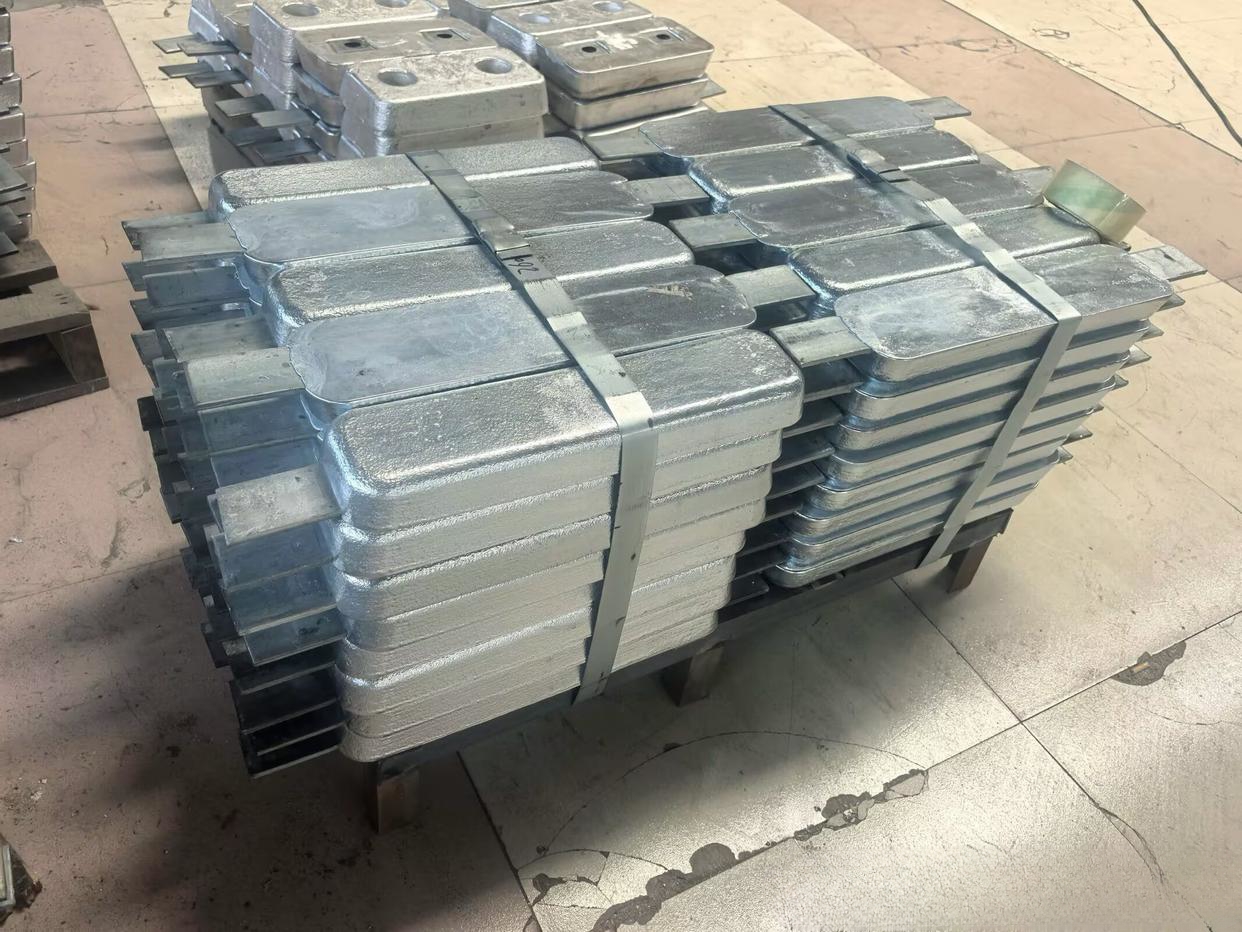
3 kg Zinc Alloy Sacrificial Anode for Boats: What It Protects and How to Install It
Short answer: A 3 kg zinc alloy sacrificial anode is a small, hull-mounted galvanic anode for local protection on small craft — propeller and rudder pockets, shaft brackets, sea chests, outboard and sterndrive housings, ballast tanks and local hull patches. It protects only while immersed in seawater or brackish water below roughly 15 Ω·m, and only if the anode face is bare metal, bonded to bare steel and left unpainted.
3 kg zinc anode at a glance
| Parameter | Typical value | Notes |
|---|---|---|
| Nominal mass | 3 kg | Excludes weld strap / core bar |
| Alloy family | Zn-Al-Cd (Zn-Al 0.1–0.5%, Cd 0.025–0.07%) | ASTM B418 Type I equivalent; also covered by Chinese standard GB/T 4950 |
| Open-circuit potential | −1.09 to −1.05 V vs SCE | Measured in seawater |
| Working potential | −1.05 to −1.00 V vs SCE | Closed-circuit value under load |
| Actual capacity in seawater | ≥ 780 Ah/kg | Basis of every lifespan calculation below |
| Current efficiency in seawater | ≥ 95% | Corrosion products shed cleanly, surface dissolves evenly |
| Suitable medium | Seawater, brackish water, low-resistivity mud | Medium resistivity typically below ~15 Ω·m |
| Not suitable for | Fresh water, high-resistivity soil, aluminium hulls | Use magnesium anodes for fresh water; aluminium anodes for aluminium hulls |
Where a 3 kg block sits in the hull anode range
Hull anodes are sized on wetted area, coating condition and current demand, so the range runs from sub-kilogram engine anodes up to multi-kilogram castings on commercial hulls. At 3 kg, this block sits at the small end of the range. In the GB/T 4950 ZH hull-anode series the smallest standard castings sit at roughly 3.5 kg, which makes a 3 kg zinc block a local-protection or space-constrained unit rather than the primary hull anode of a large vessel.
That distinction matters in practice: a 3 kg anode is normally specified either as a supplementary anode in tight geometry (rudder pintles, shaft brackets, sea chest walls) or as the main anode on a genuinely small hull — a dinghy, a workboat under about 8 m, a barge repair section, a pontoon float.
What a 3 kg zinc anode is used for
| Application | What is being protected | Why a 3 kg unit fits |
|---|---|---|
| Hull bottom and shell plating on small craft | Steel hull plate, weld seams, frames; fishing boats, yachts, workboats, barges | Limited wetted area, restricted clearance under the hull |
| Propeller, rudder, shaft and shaft bracket | Bronze propeller, rudder blade and stock, stern tube, A-bracket | Anode must sit close to the dissimilar-metal couple it is protecting |
| Outboards, sterndrives, thruster housings | Aluminium or steel gearcase and mounting hardware | Small envelope, frequent replacement, low unit cost |
| Sea chest, sea water valve box, cooling water chamber, heat exchanger | Steel or cast-iron internal surfaces with turbulent flow | Often combined with zinc rods, ribbon or small blocks |
| Ballast tanks and sea water tanks (local) | Tank walls, frames, brackets, pipeline supports | Fits through inspection openings and manholes |
| Pontoons, floating boxes, dock and jetty steelwork | Immersed steel plate and pile sections | Replaceable without lifting a large structure |
How the anode protects steel and bronze
Zinc alloy sits roughly 0.2–0.25 V more negative than steel in seawater on the galvanic series. When the two are electrically bonded and immersed, that difference drives a direct current from the anode through the seawater into the cathode — the hull, rudder or propeller — where it suppresses the anodic dissolution reaction that would otherwise consume the steel. The zinc dissolves instead. This is sacrificial anode cathodic protection in its simplest form: no rectifier, no external power, no control loop.
Two design rules follow from the mechanism, and they are the ones most often confused:
- Mass controls life. Total charge available is the mass multiplied by capacity — about 2,100 Ah for a 3 kg zinc block.
- Surface area controls current output. A 3 kg block cannot deliver the current of a 10 kg block, no matter how much metal remains. Once the anode is scaled with hard corrosion product or buried in paint, current output collapses even though most of the mass is still there.
How long does a 3 kg zinc anode last?
Lifespan is arithmetic, not guesswork, provided you know the mean current the anode is delivering:
Life (hours) = [mass (kg) × capacity (Ah/kg) × utilisation factor] ÷ mean current (A)
For a 3 kg zinc anode: 3 × 780 ≈ 2,340 Ah of theoretical charge; with a utilisation factor of about 0.90 (the last 10% of the casting cannot be consumed before the core is exposed), usable charge is roughly 2,100 Ah.
| Mean current delivered | Calculated life | Typical situation |
|---|---|---|
| 0.10 A | ~21,000 h (about 2.4 years) | Well-coated small hull, low flow, cold water |
| 0.25 A | ~8,400 h (about 1 year) | Typical annual haul-out cycle on a small steel or GRP hull |
| 0.50 A | ~4,200 h (about 5 months) | Poor coating, warm or fast-flowing water, large dissimilar-metal couple nearby |
Because current demand is not constant, the only reliable check is a hull potential survey at each haul-out. If the anode is more than about half consumed before the interval you planned for, the anode count — not the anode size — is usually what needs to change.
Installation rules that decide whether the anode works
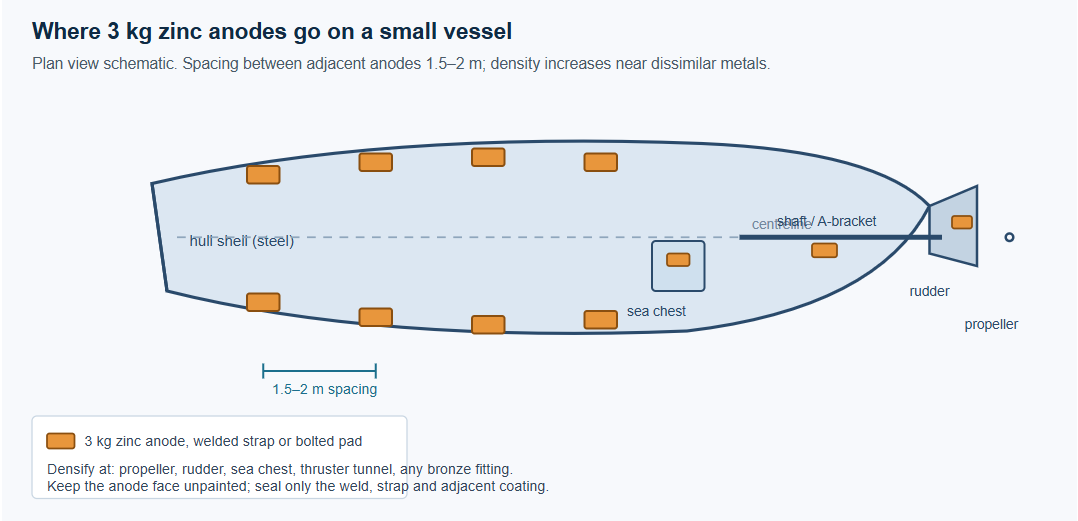
Placement principle: distribute anodes so no protected surface is more than ~2 m from the nearest anode, and tighten the spacing wherever bronze, stainless or aluminium parts sit close to steel.
1. Mount only on permanently immersed surfaces
An anode that dries out delivers nothing. A 3 kg block belongs below the light waterline, on surfaces that stay wet at rest and underway — not on the boot-top, not on a chock above the waterline, not on the deck hardware.
2. Prepare the contact face to bare metal
Grind the mounting pad and the anode core/strap contact face back to bright metal. Paint, mill scale, rust, marine growth and grease all act as dielectric layers and will isolate the anode electrically even though it is bolted tight.
3. Weld the strap, not the zinc
For welded installation, the steel strap or core bar is fully fillet-welded to the hull. For bolted installation, use a backing pad, anti-vibration washers and a torque check; the electrical bond depends on metal-to-metal contact pressure, so a loose bolt is an open circuit. Never weld on the zinc body itself.
4. Keep the working face unpainted
Anode bodies are not coated. Apply coating only to the weld, the strap, the bolt heads and the immediate surrounding plate, so the anode dissolves from a clean face and the steel around it is not left as a small bare cathode.
5. Space anodes evenly, then densify at dissimilar metals
Start with 1.5–2 m between adjacent anodes on the hull bottom, then add units at the propeller aperture, rudder, sea chest, thruster tunnel and any bronze valve or pipe penetration. Protection is a field problem: an under-protected pocket next to a bronze propeller is where pitting starts.
6. Bond the isolated fittings
Rudder stocks, stern tubes and seacocks are frequently isolated by bearings or seals. If they are not bonded to the hull, a nearby hull anode cannot protect them regardless of size. Check bonding straps before adding anode mass.
7. Do not over-protect
More anode is not automatically better. Over-protection wastes anode mass, lifts coating disbondment rates and can drive hydrogen uptake in high-strength steels and aluminium alloys. Confirm the achieved potential rather than adding another block.
Commissioning check and replacement interval
- Potential survey: with a reference electrode, the protected steel should read in the region of −0.80 to −1.00 V against a silver/silver chloride seawater electrode. Values more negative than about −1.05 V indicate over-protection on high-strength or aluminium structures.
- Visual check: look for paint bridging over the anode face, wasted straps, missing bolts, and hard white scale that has not shed.
- Replacement: common practice is to renew at haul-out once roughly half the original mass is gone. A 3 kg block that has lost 1.5 kg has done its job, not failed.
Zinc vs aluminium vs magnesium in seawater
| Alloy | Best medium | Relative capacity | Hull compatibility | Watch out for |
|---|---|---|---|---|
| Zinc (Zn-Al-Cd) | Seawater, brackish water, low-resistivity mud | Baseline (780+ Ah/kg) | Steel and GRP hulls with bronze propellers | Passivates in fresh or high-resistivity water; cadmium content is restricted in some markets |
| Aluminium (Al-Zn-In) | Seawater, estuarine water | Substantially higher per kg | Aluminium hulls; steel hulls where cadmium-free compliance is required | Requires correct alloy chemistry; unsuitable for some tank interiors |
| Magnesium | Fresh water, high-resistivity soil only | Highest driving voltage | Steel in fresh water; not for seawater service | Over-protection, coating damage and hydrogen risk in seawater |
Two specification notes follow from that table. First, cadmium-bearing zinc anodes face restriction in several markets, so projects with environmental or procurement constraints should specify Zn-Al-In sacrificial anodes with ABS certification instead. Second, on an aluminium hull, zinc is the wrong alloy regardless of price — use the aluminium anode range. The wider trade-off between the two families is covered in our analysis of why aluminium anodes perform better in seawater.
Frequently asked questions
How much steel can one 3 kg zinc anode protect?
Protection is limited by current output, not mass, so there is no fixed square-metre figure. As an illustration: painted steel in temperate seawater is commonly designed at roughly 10–20 mA/m²; a 3 kg block sustaining 0.2 A therefore covers on the order of 10–20 m² of intact coating. Bare or badly degraded coating raises the demand several-fold and cuts that area proportionally.
Can a zinc anode be painted over?
No. Coating the working face stops the dissolution reaction and turns the anode into an inert lump of metal. Coat the weld, strap and adjacent plate only.
Why has my zinc anode turned white and crusty?
White zinc corrosion product is normal, and in healthy service it sheds and exposes fresh metal. Hard, adherent scale that never falls away indicates passivation — usually low water flow, incorrect alloy chemistry or a fresh-water exposure — and the anode should be replaced rather than cleaned.
Is a zinc anode suitable for an aluminium boat?
No. Aluminium hulls should carry aluminium alloy anodes. Zinc on aluminium risks ineffective protection and localised attack, and it is the single most common alloy mismatch found on mixed-fleet pontoons.
Can I use zinc anodes in fresh water?
Not effectively. Zinc passivates in fresh or high-resistivity water; magnesium anodes are the correct choice for fresh water and high-resistivity soil.
How often should a 3 kg anode be replaced?
Inspect at every haul-out and replace once about half the mass is consumed. On a typical small craft with an annual lift, that usually means replacing on a one- to three-year cycle depending on coating condition and water temperature.
One large anode or several small ones?
Several correctly distributed anodes almost always beat one large one, because current has to reach the far end of the protected surface. On a 3 kg unit basis, use quantity to fix coverage and mass only to fix interval between haul-outs.
Do I need a different anode for a bronze propeller?
The propeller is normally protected by the hull anodes plus a dedicated shaft or propeller-nut anode, provided the shaft and propeller are bonded. Bronze in a steel hull forms a strong couple, so anode density near the aperture should be higher than on open hull bottom.
Ordering a 3 kg zinc anode
The zinc anodes for boats range covers 3 kg blocks and other small hull castings with welded steel straps or bolted pads, cast to ASTM B418 Type I chemistry and tested for capacity and efficiency before shipment. For larger hull areas, compare the zinc hull anode range or review the full zinc anode range; for complete systems, our engineers size anode count and spacing against wetted area, coating condition and service profile.
Send your hull dimensions, coating system and operating water to our engineering team and we will return an anode schedule — quantity, mass, placement and expected replacement interval — rather than a single part number.
Standards and references
- ASTM B418 — Standard Specification for Cast and Wrought Galvanic Zinc Anodes (Type I / Type II chemistry)
- GB/T 4950 — Zinc-Aluminium-Cadmium alloy sacrificial anodes (Chinese national standard)
- DNV-RP-B401 — Cathodic Protection Design (design current densities, protection criteria, anode spacing practice)
- MIL-DTL-18001 — Anodes, Sacrificial Zinc Alloy (naval specification)
- NACE/AMPP SP0387 — Metallurgical and Inspection Requirements for Cast Sacrificial Anodes

