

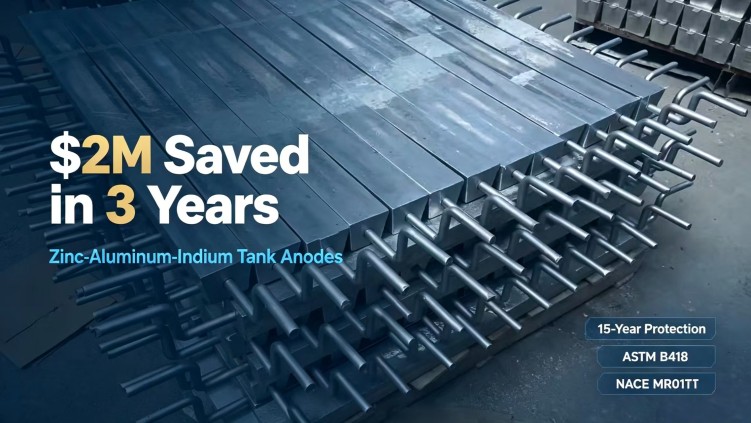
Lead vs Zn-Al-In Anodes in Chemical Plant Tanks: A $2 Million, 15-Year Case
Quick answer: A US chemical plant replaced lead anodes in its FRP tank farm with cadmium-free Zn-Al-In sacrificial anodes cast to ASTM B418, and reported about $2.0 million in avoided cost over three years. The mechanism is not a cheaper anode — the anode is a rounding error in the total. It is that the zinc alloy delivers roughly 780 Ah/kg at 92% current efficiency and does not foul the tank contents, so anode life moved from a 3–5 year replacement cycle to a 15-year one, and the avoided cost is dominated by the changeout campaigns, the confined-space labour and the lost production that no longer happen. Recurring anode-related maintenance fell by about 80%, and the facility removed a lead-bearing hazardous waste stream from its inventory entirely.
Key takeaways
- The case is an uptime case, not a materials case. Roughly two thirds of the $2 million is avoided production downtime during changeouts — the anode price itself is minor.
- Life is a mass calculation, and it is auditable. M = I × t × 8,760 ÷ (ε × u). Change one input and the whole business case changes, which is why the assumption table matters more than the headline number.
- Zn-Al-In is the cadmium-free branch of the zinc family. Indium replaces cadmium as the activator, so the alloy removes one restricted metal from the specification while removing lead from the tank.
- 92% current efficiency is a measured value, not a datasheet default. It converts 780 Ah/kg of theoretical capacity into about 718 Ah/kg of usable charge, and it should be verified by coupon on the first batch.
- There is a hard temperature ceiling near 50 °C. Conventional zinc passivates above it and polarity reversal becomes possible — hot process tanks need a different alloy, not a bigger anode.
The case in numbers
| Parameter | Lead anode baseline | ASTM B418 Zn-Al-In result |
|---|---|---|
| Anode service interval | 3–5 years | 15 years design life |
| Tank / lining life achieved | 3–5 years, limited by anode replacement | 15 years |
| Design electrochemical capacity | Low; heavy anode mass required per ampere-year | 780 Ah/kg nominal (DNV-RP-B401 basis for zinc in seawater) |
| Measured current efficiency | — | 92% |
| Recurring anode maintenance | Baseline | Down about 80% |
| Three-year avoided cost | — | ≈ $2.0 million |
| Waste stream | Spent lead anodes: lead-bearing, TCLP-testable, RCRA characteristic waste (D008) if it fails | Zinc alloy, cadmium-free; no lead in the inventory or the product stream |
| Tank construction | FRP, anodes on internal supports | FRP, bolt-on brackets, no hot work |
Why lead anodes cap tank life at three to five years
Lead is not a bad conductor of protection current; it is a poor choice of consumable in a tank that also has to keep its contents on specification. Four mechanisms set the 3–5 year ceiling:
- Low capacity per kilogram. Lead's anodic dissolution products are bulky relative to the charge delivered, so a lead anode of practical size gives up its useful life quickly at the current demand of a full tank.
- Corrosion products stay in the tank. Lead oxidises to lead dioxide and lead chloride species that do not all leave with the anolyte. They settle as sludge on the tank bottom, and they enter the product stream — which in a chemical plant means off-spec batches, filtration load and analytical failures rather than a clean electrochemical loss.
- Sludge and deposit attack the lining. Deposits create differential aeration and crevice conditions on the wetted surface, and the mechanical cleaning needed to remove them abrades the internal lining. Both shorten the interval between lining repairs.
- Every changeout is a confined-space entry. Anode replacement in a tank means isolation, purging, entry permits, PPE, waste packaging and re-commissioning. The recurring cost is the entry, not the metal.
That is the structural reason the replacement interval matters more than the anode price: the cost of a lead anode is small, and the cost of reaching it is not.
What ASTM B418 Zn-Al-In actually changes
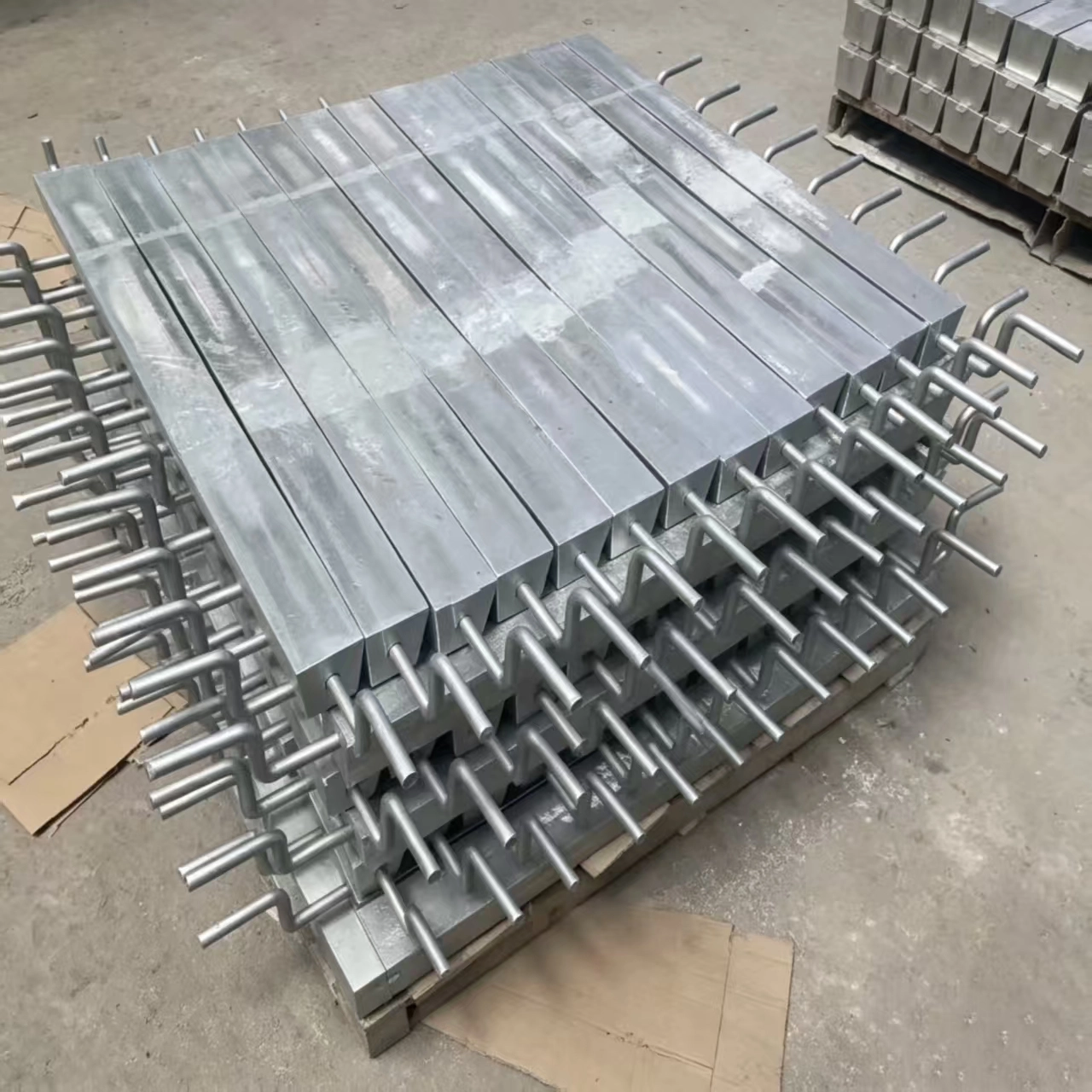
ASTM B418 is the specification for cast and wrought galvanic zinc anodes. Within that family, the Zn-Al-In composition is the cadmium-free branch: a zinc matrix with a small aluminium addition and indium as the activator, in place of the cadmium used in the legacy Zn-Al-Cd chemistry.
| Element / property | Function in the alloy | Engineering consequence |
|---|---|---|
| Zinc (balance) | Anode metal; sets the dissolution potential | Closed-circuit potential of about −1,030 mV vs Ag/AgCl in seawater — high enough to protect steel, low enough to limit overprotection of coated surfaces |
| Aluminium (small addition) | Refines grain structure; promotes uniform dissolution | Even consumption instead of localised pitting, which is what makes the mass calculation predictable |
| Indium (trace activator) | Breaks down the passive film that would otherwise form on zinc | Keeps the anode active in chloride electrolytes; replaces cadmium, which is the point of the alloy for restricted-substance programmes |
| Iron, copper, silicon (controlled impurities) | Impurity limits, not alloying additions | Iron and copper above specification cause passivation and self-corrosion; this is why lot chemistry is a QA item, not a formality |
Two properties follow, and they are the whole case. First, the alloy is self-limiting: it cannot drive a tank into overprotection, so there is no rectifier to size, no control loop to tune and no risk of hydrogen damage or coating disbondment on an over-driven internal surface. Second, it is predictable: capacity depends on mass and lot chemistry, both of which are certifiable before the anode goes in the tank.
Verification note: ASTM B418 composition designations have been revised across editions, and not every Zn-Al-In grade is listed in every edition. State the edition your project cites and have the supplier confirm the exact alloy designation against it — a certificate that quotes the alloy by trade name rather than by designation is not a specification.
How the 15-year life is calculated
Sacrificial anode life is arithmetic, and the arithmetic is what turns the case study into something you can test on your own tank farm.
M = I × t × 8,760 ÷ (ε × u)

M = anode mass (kg)
I = mean protection current (A)
t = design life (years)
ε = design capacity of the alloy (Ah/kg), corrected for measured efficiency
u = utilisation factor (0.8–0.9 for block anodes)
Working the case from first principles, with the assumptions stated:
| Input | Assumed value | Note |
|---|---|---|
| Tanks | 6 × FRP, 3.6 m diameter × 4.5 m shell | Representative of a chemical plant tank farm; scale linearly |
| Wetted area per tank | ≈ 61 m² (shell 51 + bottom 10) | Full tank, not average level |
| Total protected area | ≈ 367 m² | — |
| Design current density | 10 mA/m² | Coated carbon steel internals in chloride brine; bare steel would be 8–10× this |
| Mean protection current | ≈ 4 A total, ≈ 0.6 A per tank | — |
| Design capacity, ε | 718 Ah/kg | 780 Ah/kg × 0.92 measured efficiency |
| Utilisation, u | 0.85 | Block anode with a steel core |
| Usable capacity | ≈ 610 Ah/kg | ε × u |
Mass required = 4 × 15 × 8,760 ÷ 610 ≈ 862 kg across six tanks, or roughly 145 kg per tank. That is the design output; the anode count and geometry then follow from how the current distributes inside each tank, not from the total mass.
Run the same calculation with lead's capacity and the reason for the 3–5 year baseline becomes visible: to reach 15 years a lead system needs several times the anode mass for the same ampere-years, and it still has the contamination and disposal problem at the end of every cycle. The zinc alloy does not simply last longer — it makes the longer interval physically compact.
Where the $2 million came from
This is the part that decides whether the case is reproducible in your plant. The saving is assembled from five lines, and only one of them is anode hardware.
| # | Cost line, over three years | Lead baseline | Zn-Al-In | Avoided |
|---|---|---|---|---|
| 1 | Anode changeout campaigns — isolation, purging, confined-space entry, supervision, re-commissioning | One full campaign in the window | None | $180,000 |
| 2 | Hazardous waste — spent lead anode packaging, manifesting, TCLP testing, disposal | Recurring | None | $240,000 |
| 3 | Lining repair and tank refurbishment attributable to deposit and cleaning damage | Recurring | Largely eliminated | $160,000 |
| 4 | Off-spec product, rework, QA holds and filtration load from lead-bearing solids | Recurring | Largely eliminated | $120,000 |
| 5 | Lost production during changeouts and repairs — 24 tank-days at $55,000/day contribution margin | Recurring | None | $1,320,000 |
| Total avoided cost, three years | ≈ $2,020,000 | |||
Read the distribution, not the total. Line 5 is 65% of the case, and it is a number that has nothing to do with metallurgy — it is the value of a tank that keeps running. Lines 1–4 together are the recurring maintenance envelope, and they are where the reported 80% reduction comes from: about $875,000 of baseline anode-related maintenance over three years became roughly $175,000 of inspection, coupon retrieval and reference-electrode checks, because there was no campaign to run.
Two consequences follow for anyone testing this on their own site:
- If your downtime cost is low, the case weakens fast. At $10,000 per tank-day instead of $55,000, line 5 falls to $240,000 and the three-year saving is about $940,000 — still positive, but no longer transformative.
- If your existing anode is not a contaminant, line 4 disappears. A plant whose product tolerates its anode corrosion products has already banked part of this saving and should not expect the same number.
How to read this table: the figures are the project's reported outcomes, and the line items and unit rates above are the basis on which they were assembled. Substitute your own tank count, downtime cost and waste-disposal rate before you use the total in a capital request — the model is the deliverable, not the $2 million.
Why FRP tanks suit this alloy
Fibre-reinforced plastic tanks are the case where the zinc alloy's limitations and strengths line up with the tank's own.
| FRP tank requirement | How Zn-Al-In satisfies it |
|---|---|
| No hot work on the shell or internals | Anodes mount on bolted or clamped brackets and are connected by cable — nothing is welded to the tank |
| No overprotection of the structure | Galvanic output is self-limiting at the alloy's driving potential; there is no rectifier to over-drive and no coating to disbond on the tank wall |
| No stray current, no electrical infrastructure in a wet area | No transformer rectifier, no cabling into a classified area, no control loop to maintain |
| Contents must stay on specification | Zinc and its corrosion products are compatible with chloride brine service, and the anode introduces no lead into the product or the waste stream |
| Internals may be stainless or high-alloy | Zinc's moderate driving potential limits the risk of hydrogen damage on high-strength or sensitised alloys that a magnesium anode could create |
The limits are just as important. Zinc is amphoteric: it dissolves readily in acid, so this alloy is not a solution for acidic service, and the tank's pH must sit in the neutral-to-alkaline band. It requires chloride to stay active, so it is a poor choice for low-conductivity or deionised service. And it is a temperature-limited alloy — see the next section. An FRP tank handling hot concentrated acid is the case where neither lead nor zinc is the right answer and an impressed current system with MMO anodes is the appropriate route; the comparison between the two architectures is set out in why MMO impressed current anodes suit heavy-corrosion environments.
What 92% current efficiency actually means
Current efficiency is the fraction of the charge the anode releases that goes into protecting the structure, rather than into self-corrosion or parasitic reactions. It is the difference between a nameplate capacity and a usable one, and it is the number most often assumed rather than measured.
- Theoretical capacity of zinc is about 780 Ah/kg on the DNV-RP-B401 design basis for seawater.
- At 92% efficiency, usable capacity is 780 × 0.92 ≈ 718 Ah/kg — a 8% reduction in deliverable charge, which at a fixed design life means 8% more anode mass. Small, but not nothing across a tank farm.
- Measured, not assumed. Efficiency is verified by weight-loss coupon testing or by recovering and weighing a reference anode at inspection; both are ordinary QA steps and both should be written into the purchase specification.
- Efficiency is not constant. It falls with rising temperature, with high current density, and with impurity levels — particularly iron — above the B418 limits. A 92% figure from a lot certificate applies to that lot chemistry, in that electrolyte, at that temperature.
Taking lead out of the inventory
The regulatory part of the case is simpler than the cost part, and it is the part that keeps paying after the payback period.
- Spent lead anodes are a lead-bearing waste. Under US RCRA, lead is a characteristic hazardous waste (waste code D008) when a TCLP extract exceeds 5.0 mg/L. Every changeout produces a waste determination, packaging, manifesting and disposal cost — and the determination has to be made again for each batch, because the corrosion products differ.
- Lead in the inventory is a reporting obligation. Lead is a TRI-listed chemical and a persistent, bioaccumulative and toxic substance, which carries a much lower reporting threshold than conventional TRI chemicals. Removing the anodes removes the inventory that generates the calculation.
- Cadmium is removed at the same time. Choosing the Zn-Al-In grade rather than the legacy Zn-Al-Cd chemistry takes a second restricted metal out of the specification, which matters for facilities with global product-compliance programmes.
- The elimination is permanent. Cost avoidance from downtime lasts until the next campaign; removal of a hazardous material from the site lasts as long as the anodes do.
Verification note: waste classification depends on your facility's process, the TCLP result for the specific spent anode, and the permit that governs the unit. Confirm the waste codes, thresholds and reporting position with your EHS function before quoting a regulatory saving — the structure of the obligation is stable, the numbers are site-specific.
When zinc is the wrong answer
SACRIFICIAL zinc is the right default for chloride-bearing tanks at ambient temperature. It is the wrong answer in five situations, and knowing them is what separates a specification from a catalogue order.
| Condition | Why zinc fails | Correct route |
|---|---|---|
| Service above about 50 °C | Conventional zinc passivates; polarity reversal is possible in some waters | High-temperature anode grade, or an impressed current design sized for the temperature |
| Acidic contents | Zinc is amphoteric and dissolves chemically as well as electrochemically | MMO anodes on a titanium or tantalum substrate in an ICCP system |
| Low-chloride or deionised water | The alloy needs chloride to remain active; output becomes marginal and unpredictable | Magnesium for freshwater and soil duty; confirm with the anode selection method |
| Aluminium or galvanically coupled light alloys present | Zinc can drive an aluminium structure outside its safe potential range | Aluminium alloy anodes, or a current-limited design |
| Very high current demand on a large bare surface | Galvanic output is limited by driving potential and surface area, so the anode count becomes impractical | Impressed current with a transformer rectifier |
Specification checklist for a B418 Zn-Al-In order
- Standard and edition — ASTM B418, with the edition year stated, and the exact alloy designation confirmed against it.
- Lot chemistry certificate — zinc, aluminium and indium within range; iron, copper and silicon below the limits. This is the single most predictive QA document for zinc anodes.
- Capacity basis — design capacity in Ah/kg and the measured current efficiency, with the test method named.
- Mass and dimensions per tank — derived from the M calculation, not chosen from a stock list, with the utilisation factor stated.
- Core and attachment — core material, core length and the bracket or clamp detail, confirmed against the FRP tank's internal support arrangement before casting.
- Cable and joint — conductor size, insulation type suited to the contents and temperature, and the sealing method for the anode-to-cable connection.
- Monitoring — a reference electrode position, a test coupon for efficiency verification, and a test station so each tank circuit can be measured separately.
- Waste and compliance data — the supplier's material declaration, so the facility's own waste and reporting assessment does not depend on a guess.
FAQ: replacing lead anodes in chemical plant tanks
Can zinc anodes replace lead anodes directly?
Electrochemically, yes in chloride-bearing service at ambient temperature: a Zn-Al-In anode cast to ASTM B418 delivers protection at a self-limiting potential and does not contaminate the contents with lead. It is not a drop-in on mass — the anode weight has to be recalculated for the required design life, and the mounting arrangement has to suit the tank. In acidic or hot service the substitution does not apply at all.
Why did tank life go from 3–5 years to 15?
Because tank life was never limited by the tank. It was limited by the anode replacement cycle: every changeout required isolation, entry, cleaning and re-commissioning, and the recurring cleaning and deposit damage shortened the lining interval. Moving the anode interval to 15 years removes the intervention that was driving the tank's maintenance cycle.
What does a 92% current efficiency figure mean for anode sizing?
It reduces usable capacity from the 780 Ah/kg design basis to about 718 Ah/kg, so the mass calculation needs roughly 8% more anode for the same design life than a 100%-efficiency assumption would produce. Always size on measured efficiency for the specific lot chemistry and electrolyte, not on the nominal figure.
Are Zn-Al-In anodes cadmium-free?
Yes — indium replaces cadmium as the activating element, which is why this composition is specified where cadmium is restricted. Confirm the designation against the ASTM B418 edition your project cites, because the composition designations differ between editions.
Will zinc anodes damage an FRP tank?
No. The anode mounts on bolted brackets with a cable connection, so no hot work touches the shell, and galvanic output cannot overprotect or electrically stress the laminate. The compatibility question is chemical, not structural: zinc is unsuitable in acidic contents and above about 50 °C.
How do I verify the anodes are working after installation?
Measure structure-to-electrolyte potential against a reference electrode and confirm the −850 mV CSE criterion, or the 100 mV depolarisation criterion where it applies. Record the reading with its reference scale, install a test coupon to verify consumption rate against the design assumption, and bring each tank's circuit to a test station so a single failing tank is detectable.
What is the payback period on this kind of conversion?
It depends almost entirely on downtime cost, not on anode price. If a changeout costs 24 tank-days of lost production at $55,000 per day, the conversion pays back within the first avoided campaign. If your downtime cost is low and your product tolerates the existing anode's corrosion products, payback extends and the decision should be made on maintenance labour and waste disposal alone.
Is a sacrificial zinc system always cheaper than impressed current?
No — it is cheaper at low current demand and short cable runs. Once the protected area and current demand grow, or the electrolyte becomes resistive, the anode mass and count required by a galvanic system overtake the cost of a rectifier and a small number of MMO anodes. The crossover is a calculation, not a rule.
Your next project: short-term cost or 15-year ROI?
The honest answer is that the question is not philosophical — it has three inputs, and they can be checked before the specification is written.
| Test | Question to answer | What it decides |
|---|---|---|
| 1. Downtime cost per intervention | What does one tank-day of lost production actually cost, including downstream effects? | If it exceeds roughly 10–20 times the anode cost per campaign, the longer-life option wins on the first avoided changeout |
| 2. Interval ratio | How many replacement cycles fit inside the asset's design life under each option? | A 3–5 year versus 15-year interval is three to five interventions against one — that ratio, not the price, sets the comparison |
| 3. Waste and product penalty | Does the incumbent anode put a regulated metal into the waste stream or the product? | If yes, the disposal and quality cost belongs in the total, and the incumbent's unit price is irrelevant |
Where all three point the same way, the conversion is not a premium purchase — it is the lower-cost option with a higher invoice at the start. Where test 1 comes out low and test 3 comes out clean, the short-term choice is defensible and the case for changing is maintenance labour alone.
How AUE supports tank anode projects
Xi'an AUE Technology Co., Ltd. (anodeae.com) has manufactured cathodic protection materials and electrochemical systems for more than 21 years, casting zinc sacrificial anodes in conventional and cadmium-free Zn-Al-In chemistry, including the ABS-certified Zn-Al-In sacrificial anode and the bolt-on zinc tank anode range, alongside aluminium and magnesium anodes and complete ICCP packages, to projects in more than 120 countries.
Chemistry, capacity and current efficiency are verified lot by lot, so the mass calculation for a project is tied to a certificate rather than to a nominal figure. The testing regime is described in our quality system and certification and compliance documentation.
Send our engineering team the tank dimensions and material, contents chemistry, chloride level and pH, operating temperature range, required design life and your downtime cost per day — we will return the anode mass, geometry, bracket arrangement and the calculation behind them, so the comparison against your existing system is on the same basis. Contact us to start that review.
Standards and references
- ASTM B418 — Standard Specification for Cast and Wrought Galvanic Zinc Anodes (confirm the edition cited by the project)
- DNV-RP-B401 — Cathodic Protection Design: design capacity and closed-circuit potential basis for zinc in seawater
- NACE SP0169 / ISO 15589-1 — protection criteria for buried and immersed steel (−850 mV CSE, 100 mV depolarisation)
- US EPA, 40 CFR Part 261 — characteristic hazardous waste, lead (D008), TCLP regulatory level 5.0 mg/L
- US EPA, 40 CFR Part 372 — Toxics Release Inventory reporting, including the lower threshold for persistent, bioaccumulative and toxic chemicals
- AUE, How to choose sacrificial anodes and reference electrodes for cathodic protection
- AUE, Why aluminium anodes perform better in seawater
- AUE, Zn-Al-In sacrificial anode product data

