

Cathodic Protection: ICCP vs Sacrificial Anodes — How to Choose the Right System
Quick answer: Choose impressed current cathodic protection (ICCP) when the asset is large, needs more than a few amperes of protection current, has a design life beyond 15 years and has access to mains power. Choose sacrificial anode cathodic protection (SACP) when the asset is small or remote, has no power available, or needs a low-maintenance retrofit. The dividing line is almost never the technology itself — it is current demand, electrolyte resistivity and whether anyone will be there to maintain a transformer rectifier.
Updated November 2026 · Reading time ≈ 10 minutes · AUE Corrosion Engineering Team, Xi'an AUE Technology Co., Ltd.
Key facts at a glance
| Criterion | ICCP (impressed current) | SACP (sacrificial anode) |
|---|---|---|
| Driving voltage | Adjustable, typically 10–50 V DC from a transformer rectifier | Fixed by the alloy pair, typically 0.2–0.9 V of useful drive |
| Current per anode | Amperes to tens of amperes | Milliamperes to a few amperes |
| Anode materials | MMO-coated titanium, high silicon cast iron, platinised titanium, lead alloys | Magnesium, zinc, aluminium-zinc-indium alloys |
| Anode design life | 15–25+ years; rectifier needs scheduled maintenance | 3–15 years, set by anode mass |
| Power supply | Required — AC feed to a transformer rectifier | None |
| Output regulation | Continuously adjustable; can be remotely monitored | Not adjustable — set once by anode mass and alloy |
| Typical failure mode | Rectifier outage, groundbed drying out, stray-current interference | Insufficient output in high-resistivity electrolyte, anode consumed |
| Best fit | Pipelines, tank farms, offshore structures, concrete, large immersed steel | Hulls, piles, small buried pipe, water heaters, remote assets |
What cathodic protection actually does
Cathodic protection (CP) forces a buried, immersed or embedded steel structure to behave as the cathode of an electrochemical cell. Instead of iron dissolving into the electrolyte at anodic sites, electrons are supplied to the whole surface from an external source, and the anodic reaction is suppressed before it starts.
Two consequences follow, and both matter for system selection:
- CP does not remove corrosion. It removes the driving force. If the coating is intact and the current is adequate, no metal is lost. If the current stops, corrosion resumes the same day.
- CP only works where there is an electrolyte. Soil, seawater, fresh water, concrete pore water, tank contents. Above the waterline or in dry sand, the coating does the entire job.
The underlying electrochemistry, including why the whole structure must be polarised rather than protected point by point, is covered in our guide to cathodic protection and how it protects metal from corrosion.
The two system families
Impressed current cathodic protection (ICCP)
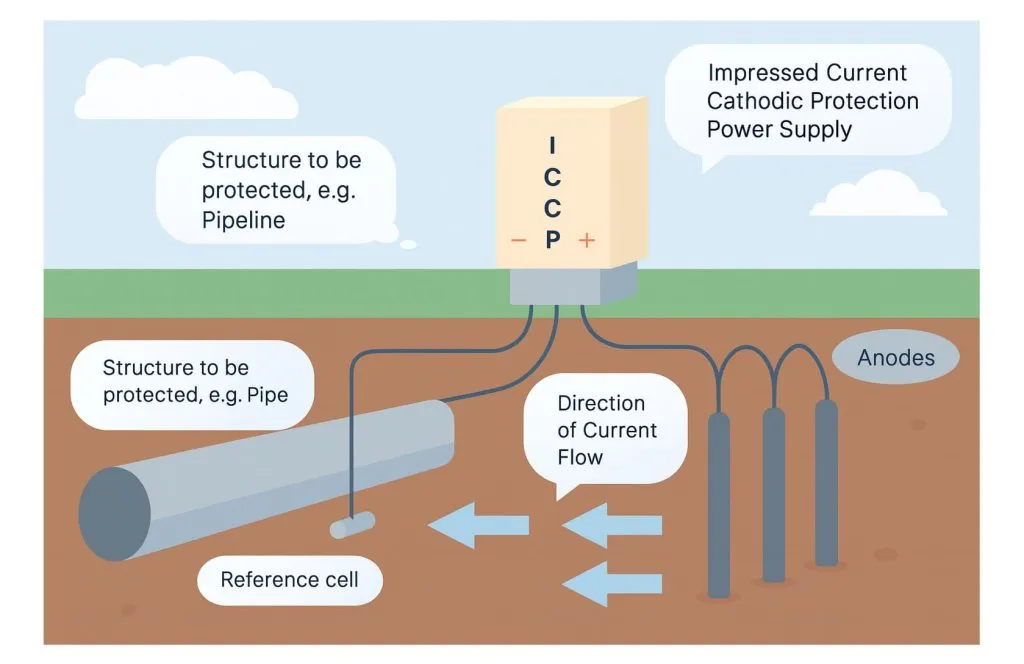
An ICCP system uses an external DC power source — the transformer rectifier — to drive current from inert anodes through the electrolyte and onto the structure. Because the driving voltage is supplied externally, the current output is limited by the rectifier rating and the anode's ability to discharge current, not by the galvanic potential of the anode metal.
That is what makes ICCP practical on large assets: one rectifier can protect tens of kilometres of pipeline or the entire submerged surface of an offshore jacket.
Anode materials used in ICCP:
| Anode | Where it is used | Why |
|---|---|---|
| MMO-coated titanium | Seawater, concrete, tank bottoms, buried service with coke breeze backfill | Dimensionally stable, very high current density, lightweight, long life |
| High silicon cast iron (HSCI) | Buried groundbeds, deep wells, offshore | Robust and economical for large groundbeds; consumes slowly and predictably |
| Platinised titanium | Ship hulls, heat exchangers, seawater systems | Very high current density, tolerant of chlorides |
| Lead alloy anodes | Specialist marine and immersed duty | Long-established marine solution where specified |
Explore the full impressed current anode range, or go directly to MMO anodes and high silicon cast iron anodes.
Sacrificial anode cathodic protection (SACP)
A sacrificial system needs no power at all. A metal that is electrochemically more active than the structure — magnesium, zinc or an aluminium alloy — is bonded to it and corrodes in its place. The protected structure becomes the cathode and is not consumed.
The anode corrodes; the structure does not. That single sentence is the whole principle, and it is also where most non-specialist descriptions get it backwards.
Anode materials used in SACP:
| Anode | Best environment | Note |
|---|---|---|
| Magnesium alloys | High-resistivity soil, fresh water, tank and water-heater interiors | Highest drive of the three; never use on aluminium hulls |
| Zinc alloys | Seawater, low-resistivity soil, steel hulls | Steady, predictable, well-established specifications |
| Aluminium-zinc-indium alloys | Seawater, offshore, hulls | Highest capacity per kilogram of the three |
See the sacrificial anode range and the dedicated magnesium, zinc and aluminium collections.
Which system fits which asset
| Situation | Recommended system | Reason |
|---|---|---|
| Long-distance buried pipeline | ICCP | Current demand scales with length; sacrificial mass becomes uneconomic |
| Above-ground storage tank bottom | ICCP | Large area, low current density, needs regulated output |
| Offshore platform / jacket | ICCP, often with SACP retrofit | High current demand plus long design life |
| Ship hull and running gear | ICCP for large vessels, SACP for small craft | Driven by hull area and whether power is available |
| Reinforced concrete (jetty, bridge deck, tunnel lining) | ICCP | Concrete resistivity is too high for sacrificial output |
| Small buried pipe, isolated or remote | SACP | No power available; modest current demand |
| Steel piles in seawater | SACP (aluminium bracelet) or ICCP | Depends on pile count and access for maintenance |
| Domestic or commercial water heater | SACP | Trivial current demand, zero maintenance budget |
| Asset with no reliable electrical supply | SACP | A rectifier without power is not a protection system |
The single most common specification error is choosing ICCP for an asset where nobody will maintain the rectifier. An ICCP system that trips and stays off is worse than a correctly sized sacrificial system, because the owner believes the asset is protected.
Selecting the anode material
Anode selection is driven by electrolyte resistivity, current density limits and design life — not by catalogue habit.
| Electrolyte | Resistivity / conductivity | Practical anode choice |
|---|---|---|
| Seawater | Very low resistivity | MMO titanium, platinised titanium, Al-Zn-In, zinc |
| Brackish / estuarine | Low to moderate | Zinc, aluminium (verify salinity stability), MMO |
| Fresh water | Moderate to high | Magnesium (sacrificial); MMO with sufficient surface area (ICCP) |
| Wet soil, low resistivity | < 2,000 Ω·cm | Zinc, HSCI, MMO with backfill |
| Dry soil, high resistivity | > 10,000 Ω·cm | Magnesium (sacrificial); HSCI deep well (ICCP) |
| Concrete | High | MMO mesh or ribbon, or conductive coating |
Two constraints override the table:
- Aluminium anodes are for seawater only. In fresh or low-salinity water they passivate and output collapses.
- Magnesium anodes must never be used on aluminium structures. Their drive potential overprotects aluminium and attacks the protective oxide layer.
For a structured comparison of sacrificial alloys by application, see how to choose sacrificial anodes and reference electrodes.
The design sequence, in five steps
Every CP design, ICCP or sacrificial, follows the same mass-and-current logic. Class societies and standards publish the input values; the sequence below is the structure used in DNV-RP-B401, ISO 15589-1 and NACE SP0169.
1. Establish current demand
I=A×ic×fcI=A×ic×fc
Wetted or buried area × design current density × coating breakdown factor. This number decides which family you are in: below roughly 5 A, sacrificial is usually viable; above that, ICCP almost always wins on lifecycle cost.
2. Size the anode groundbed
For a vertical anode in homogeneous soil, the anode-to-electrolyte resistance follows the Dwight relationship:
R=ρ2πL(ln8Ld−1)R=2πLρ(lnd8L−1)
With ρ in Ω·cm, L the anode length in cm and d its diameter in cm. Multiple anodes in parallel reduce resistance, but mutual interference means the reduction is never the simple 1/n you would get from resistors alone.
3. Rate the transformer rectifier
VTR=I×(Ranode+Rcable+Rstructure)+VbackVTR=I×(Ranode+Rcable+Rstructure)+Vback
The back EMF term is typically around 2 V for steel; the rest is resistive loss you must actually pay for in rectifier capacity. Add 25–50% headroom for coating degradation over the design life.
4. Design the monitoring circuit
Permanent reference electrodes, coupons and test posts are not optional extras — without them you cannot prove the system works, and you cannot tell overprotection from underprotection.
5. Specify the accessories that keep the circuit closed
Transformer rectifiers, cathodic protection cable, junction boxes, insulating flange kits, solid-state decouplers for AC mitigation and grounding, and calcined petroleum coke backfill for buried groundbeds. A design that stops at the anode is incomplete.
How you prove the system is working
CP is a measured condition, not an installed device. The acceptance criteria below are the ones used in practice on buried and immersed steel:
| Criterion | Value | Applies to |
|---|---|---|
| Protection potential | −850 mV vs Cu/CuSO₄ (IR-free) | Buried and immersed steel |
| Alternative criterion | 100 mV polarisation shift from native potential | Where −850 mV is impractical or causes interference |
| Marine criterion | About −800 mV vs Ag/AgCl | Steel in seawater (DNV-RP-B401) |
| Overprotection limit | More negative than roughly −1,200 mV vs Cu/CuSO₄ | Coating disbondment and hydrogen embrittlement risk |
Two practical notes that decide whether a survey means anything:
- IR drop must be accounted for. A "−850 mV" reading taken with the reference electrode in the wrong place can be off by hundreds of millivolts. Current interruption or an IR-free coupon is how you remove it.
- Overprotection is a failure mode, not extra safety. Pushing potentials more negative than necessary disbonds coatings, embrittles high-strength steels and, on aluminium, causes alkaline attack.
Where system selection usually goes wrong
- Undersized groundbed. The rectifier has capacity, but the anode-to-electrolyte resistance is too high to deliver the current. Symptom: maximum rectifier voltage, insufficient protection current.
- Coating condition assumed, not measured. Coating breakdown factors are the single biggest lever on current demand. A design that assumes intact coating on a 25-year-old pipeline is a fiction.
- Stray-current interference ignored. ICCP on one structure can accelerate corrosion on a neighbouring pipeline or vessel. Interference testing is part of the design, not an afterthought.
- Sacrificial system sized by "anodes per metre". Anode spacing shortcuts ignore current demand and electrolyte resistivity, and fail first in high-resistivity soil.
Typical applications and the products that serve them
| Application | System | Typical anode / accessory |
|---|---|---|
| Buried pipeline, long distance | ICCP | High silicon cast iron anode in a deep-well groundbed |
| Tank bottom, above-ground storage | ICCP | MMO ribbon anode or flexible MMO anode |
| Offshore platform | ICCP + retrofit SACP | Pre-packaged deep well system, MMO canister anode |
| Ship hull, large vessel | ICCP | MMO coated disc anode for hull ICCP |
| Water treatment and cooling water | ICCP | MMO tube anode |
| Heat exchanger / condenser | ICCP | MMO coated titanium anode |
| Reinforced concrete | ICCP | MMO mesh anode group |
| Small buried pipe, remote | SACP | 32 lb pre-packaged magnesium anode |
| Steel pile, seawater | SACP | Aluminium alloy bracelet anode |
| Water heater | SACP | Magnesium anode rod |
Reference electrodes for verification: portable Cu/CuSO₄, Ag/AgCl for seawater and MnO₂.
Standards referenced
- NACE SP0169 — Control of External Corrosion on Underground or Submerged Metallic Piping Systems: protection criteria for buried steel.
- ISO 15589-1 — Cathodic protection of pipeline transportation systems — Part 1: On-land pipelines.
- DNV-RP-B401 — Cathodic Protection Design: marine current densities, anode mass and potential criteria.
- ISO 12473 — General principles of cathodic protection in sea water.
- ISO 12696 — Cathodic protection of steel in concrete.
Frequently asked questions
What is the main difference between ICCP and sacrificial anode systems?
ICCP uses an external DC supply — a transformer rectifier — to push current from inert anodes onto the structure, so output is high and adjustable. A sacrificial system relies on the natural potential difference between the anode alloy and the steel, so output is fixed and modest. ICCP suits large assets with power available; sacrificial suits small, remote or retrofit assets.
When should I not use ICCP?
When there is no reliable electrical supply, when the current demand is only a few amperes, when the asset is too small to justify a rectifier and its maintenance, or when stray-current interference with neighbouring structures cannot be managed.
How long does a cathodic protection system last?
ICCP anodes are commonly designed for 15–25 years, with the rectifier requiring scheduled maintenance and occasional replacement. Sacrificial anodes last 3–15 years depending on mass and current output. Well-designed systems routinely deliver more than 20 years of protection, but only if the monitoring and maintenance regime is actually followed.
Can I use sacrificial anodes and ICCP on the same structure?
Yes, and it is common on offshore structures and older pipelines: sacrificial anodes provide baseline protection and ICCP supplies the bulk current, or sacrificial anodes handle isolated components that cannot be bonded into the ICCP circuit. The two systems must be designed together, not added independently.
Why does my rectifier show maximum voltage but the structure is still corroding?
That is the classic signature of an undersized or dried-out groundbed: the anode-to-electrolyte resistance is too high to deliver the required current. Check groundbed resistance, backfill condition and anode consumption before assuming the rectifier is faulty.
How often should cathodic protection be surveyed?
Annually as a minimum for buried and immersed assets, more frequently where coating is aging or interference risk is high. Potential surveys, close-interval surveys and rectifier readings should all be trended — a single reading tells you very little.
Is cathodic protection effective on reinforced concrete?
Yes, but only as ICCP. Concrete resistivity is far too high for sacrificial anodes to deliver useful current, and the system needs MMO mesh or ribbon anodes, a conductive overlay or grout, and permanent reference electrodes embedded in the structure.
More answers are collected in our anode FAQ.
Getting the selection right the first time
The wrong system does not fail loudly — it fails quietly, over years, at the wall thickness. ICCP gives you high, regulated current for large assets; sacrificial anodes give you autonomy where no power exists. Everything else is a calculation: current demand, electrolyte resistivity, design life and who will maintain it.
Send us the asset type, dimensions, electrolyte conditions and design life, and our engineers will return a system recommendation with anode schedule, rectifier rating and monitoring plan — talk to our corrosion team.
Published by Xi'an AUE Technology Co., Ltd. (anodeae.com), a manufacturer of cathodic protection materials with more than 21 years of experience in sacrificial anode and electrochemical system production.

