

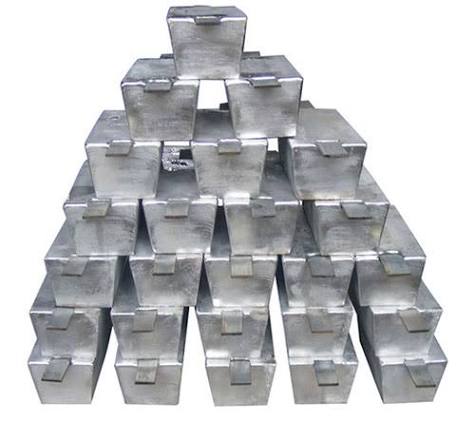
Magnesium vs Aluminium Sacrificial Anodes: Application Scenarios and Material Selection Guide
Short answer: Magnesium anodes are for high-resistivity electrolytes — dry or rocky soil, buried pipelines, tank bottoms, grounding grids and fresh water. Aluminium anodes are for seawater, brackish water and chloride-bearing brines — ship hulls, harbour piles, ballast tanks and salt-water tank interiors. Zinc sits between them but only works in low-resistivity water. The selection is decided by electrolyte resistivity and driving voltage, not by price per kilogram, and the costliest error in the field is a zinc anode specified in dry, high-resistivity soil.
Decision matrix: which anode alloy for which environment
| Electrolyte / asset | Typical resistivity | Recommended alloy | Why |
|---|---|---|---|
| Seawater: ship hulls, harbour piles, offshore structures | ~0.15–1 Ω·m | Aluminium (Al-Zn-In) | Highest capacity per kilogram in chloride water; lowest weight and installed cost for a given charge |
| Brackish and estuarine water | ~1–10 Ω·m | Aluminium | Stays active across the salinity swing of tidal and river-mouth service |
| Brine, produced water, salt-water tank interiors | ~0.1–5 Ω·m | Aluminium, or zinc where cadmium-free chemistry is not required | Chloride-rich electrolyte keeps the anode film soluble |
| Fresh water: river craft, canal boats, water tanks | ~10–100 Ω·m | Magnesium | High driving voltage overcomes the resistive electrolyte |
| Buried pipelines, tank bottoms in moist aggressive soil | ~5–50 Ω·m | Standard-potential magnesium | Sufficient drive with longer life than high-potential alloy |
| Dry, rocky or high-resistivity soil; grounding grids; poorly coated structures | ~50–1,000 Ω·m and above | High-potential magnesium | Only alloy with enough negative potential to push current through the soil |
| Low-resistivity, well-aerated soil | below ~20 Ω·m | Zinc (with gypsum-bentonite backfill) | Lower drive is adequate; zinc has the longest soil service life and lowest self-corrosion |
Read the table as a first filter, not a design. Final selection follows a current-demand calculation and a structure-to-electrolyte potential survey on the actual asset.
The variable that decides the alloy: electrolyte resistivity
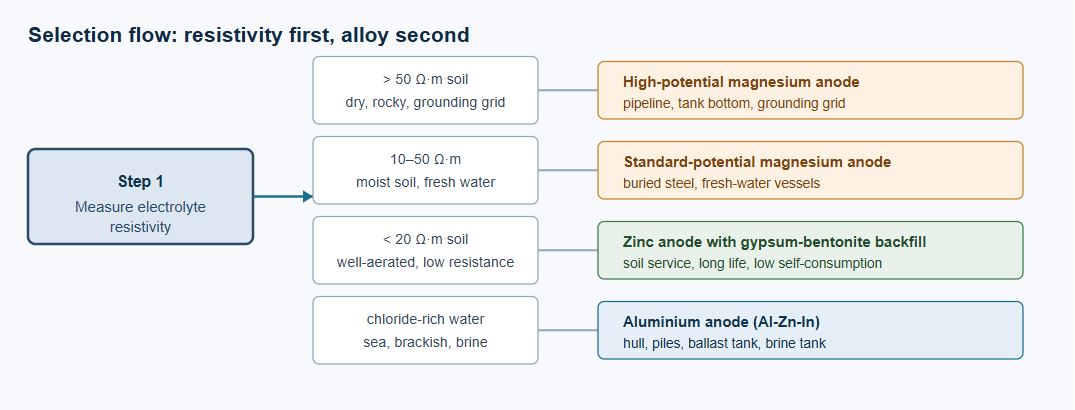
A sacrificial anode must generate enough driving voltage to push protective current across the electrolyte to the structure. In a resistive electrolyte, that voltage is consumed by the water or soil itself, so the anode's own potential becomes the limiting factor. This is why anode selection is fundamentally a resistivity problem:
- High-resistivity electrolyte (>50 Ω·m) demands the most negative practical potential — magnesium, and specifically high-potential magnesium.
- Moderate resistivity (10–50 Ω·m) allows standard-potential magnesium or, in low-resistivity soil, zinc.
- Low-resistivity, chloride-rich electrolyte (<10 Ω·m) makes current easy to move, so the constraint flips to weight, cost and consumption rate — which is where aluminium wins.
- Magnesium is chosen for voltage, aluminium for charge density. Zinc remains valid only where resistivity is low enough for its smaller driving voltage to work.
Magnesium anodes: the answer for high-resistivity ground
Magnesium carries the most negative practical potential of any sacrificial anode material, which is why it dominates dry and high-resistivity soil. Our cast magnesium anodes are specified for soil in the 1,000–10,000 Ω·cm band, and the same alloy family serves fresh-water vessels, water storage tanks, heat exchangers and travelling screens.
High-potential versus standard-potential magnesium
The two grades are not interchangeable, and choosing between them is a life-cycle decision rather than a preference:
| Grade | When it is the right call | Trade-off |
|---|---|---|
| High-potential | Dry, rocky or resistant earth; poorly coated structures; grounding grids where extra current is required | Higher self-consumption, so a shorter service life for the same mass |
| Standard-potential | Corrosive (low-resistivity) soil, well-coated structures | Lower current output, but noticeably longer life than the high-potential alloy |
That trade-off is the reason a design that over-specifies high-potential magnesium to "be safe" often produces a shorter replacement cycle and a higher life-cycle cost than a properly calculated standard-potential installation.
Where magnesium is the wrong answer
- Seawater and brine. The potential is more negative than the electrolyte requires, so the anode drives excess current, consumes itself quickly and can disbond coatings. On high-strength steels and aluminium structures, over-protection also raises hydrogen-related cracking risk.
- Hot service or confined vapour spaces. Magnesium alloys are reactive; hydrogen evolution in enclosed spaces needs an explicit risk review.
- Long-life, low-current duties in low-resistivity water. Consumption rate, not driving voltage, becomes the constraint — aluminium or zinc will outlast magnesium.
Aluminium anodes: the marine and brine default
In chloride-bearing water, aluminium alloys (Al-Zn-In and its variants) deliver roughly three times the ampere-hour capacity per kilogram of zinc alloys. In practice, that means about 1.3 kg of aluminium alloy carries the same protective charge as roughly 4 kg of zinc — a difference that shows up in freight, handling, hull weight and installation labour before it ever shows up in the material invoice. Standardised hull castings are available across the range, from small aluminium anodes for boats to the larger aluminium hull anode sizes.
Where aluminium earns its place:
- Ship hulls and running gear — seawater is the ideal electrolyte for Al-Zn-In; the alloy stays active instead of passivating.
- Harbour piles, jetties and pontoons — long immersed lengths where anode count, not anode size, drives cost.
- Ballast tanks and salt-water tank interiors — chloride content keeps the surface film soluble, and higher capacity offsets restricted access for replacement.
- Aluminium hulls and structures — the alloy family is compatible with the base metal, unlike zinc or magnesium.
Two constraints matter. First, aluminium anodes are ineffective in fresh water and in soil, where the protective film stabilises and the anode stops working. Second, cadmium-bearing variants face restriction in several markets, so specifications increasingly call for cadmium-free Al-Zn-In chemistry with third-party certification. The electrochemical case for the family is set out in our analysis of why aluminium anodes perform better in seawater.
Zinc: still correct, but in a much narrower window
Zinc remains a sound choice for low-resistivity, well-aerated soil and for small seawater castings where current demand is modest — a 3 kg hull block is a typical example. What zinc cannot do is carry a system in dry or resistive ground: its driving voltage is simply too low, the anode polarises, and the structure stays under-protected while the anode still loses mass. This is the single most common and most expensive material mismatch in cathodic protection, and it usually surfaces years later as pitting on a pipeline or tank bottom that was believed to be protected.
Cost model: compare installed charge, not price per kilogram
Anode procurement is frequently decided on price per kilogram, which is the wrong unit. The comparable unit is installed ampere-hour capacity, and it can be calculated before any quotation is requested:
Required anode mass (kg) = [mean current (A) × design life (h)] ÷ [capacity (Ah/kg) × current efficiency × utilisation factor]
Using published typical values — zinc at 780 Ah/kg and seawater efficiency around 95%, aluminium alloys at roughly three times that capacity — the same charge requirement converts into very different masses. For a 1,000 Ah requirement the comparison is roughly 1.3 kg of aluminium alloy against about 4 kg of zinc alloy. Weight, freight, handling and diver or ROV time then follow the mass, not the invoice.
The calculation also exposes the cost of a mismatch: an under-driven anode does not just protect less, it fails earlier than its mass suggests, so the asset pays twice — once for the wrong anode and again for the premature intervention.
Prepackaged anodes: why procurement is shifting
An increasing share of buried and tank-bottom specifications now call for factory-assembled, prepackaged anodes rather than bare castings. The reason is repeatability. A prepackaged unit arrives with a controlled backfill — typically gypsum, bentonite and sodium sulphate blended for the target soil — around the anode, a cable connection sealed at the factory, and a documented output that does not depend on how the installation crew mixed material on site.
Three practical effects follow:
- Stable anode environment. Backfill holds moisture against the anode and keeps the dissolution products mobile, so current output stays predictable instead of drifting with soil conditions.
- Lower field labour and fewer failure points. Excavation, lowering and backfilling dominate installation cost; a single factory assembly removes the on-site mixing step and the cable splice that most often fails.
- Verifiable quality. Chemistry, mass, cable seal and backfill are inspected before shipment, which matters on projects where the anode is buried and cannot be re-inspected.
Typical configurations include 32 lb prepacked magnesium anode assemblies for pipeline and tank work, with backfill material specified separately only for impressed current groundbeds, where calcined petroleum coke is the correct medium rather than a gypsum-bentonite blend.
Five mismatches that fail a cathodic protection system
| Mismatch | Field symptom | Correct approach |
|---|---|---|
| Zinc anode in dry, high-resistivity soil | Structure stays below protection criteria; anode barely consumed | High-potential magnesium, or an impressed current system |
| Magnesium anode in seawater | Rapid consumption, coating disbondment, over-protection | Aluminium (or zinc on small low-demand craft) |
| Aluminium anode in fresh water or soil | Anode passivates, current output collapses | Magnesium for fresh water; magnesium or zinc in soil |
| High-potential magnesium on a well-coated structure in corrosive soil | Over-protection plus short replacement cycle | Standard-potential magnesium |
| Bare casting buried without backfill | Erratic output, localised drying, inconsistent current | Prepackaged anode with specified backfill |
Renewal cycles are resetting material demand
Ageing petrochemical and chemical plants are being refurbished or retired across most industrial markets, and every one of those decisions resets an anode schedule. Three drivers sit behind the current wave: corrosion allowances consumed on 1980s and 1990s assets, tighter environmental rules on leakage and soil contamination, and life-cycle cost pressure that makes a 20-year design preferable to repeated interventions.
The procurement consequence is that anode demand is no longer steady-state replacement; it is project-driven and specification-driven. Buyers now ask for material certificates, capacity test data and a documented selection rationale, because the anode is a small line item inside a large capital decision and a wrong alloy is expensive to reverse once buried or welded on.
Frequently asked questions
Magnesium or aluminium anode for a buried pipeline?
Magnesium, in almost all soil conditions. Aluminium anodes require a chloride-rich electrolyte and are not an option for buried steel. Choose high-potential magnesium in dry or high-resistivity ground and standard-potential magnesium in moist, corrosive soil, then confirm the count against a current-demand calculation.
Can I use magnesium anodes on a ship hull?
No. In seawater, magnesium over-drives the system: it is consumed rapidly, damages coatings and creates hydrogen risk on high-strength steels. Use aluminium anodes for hulls, ballast tanks and running gear.
Why is my zinc anode not protecting the structure?
The usual cause is resistivity. Zinc's driving voltage is too low for dry or high-resistivity soil, so the anode polarises and output falls to near zero while the structure remains under-protected. Re-survey the electrolyte resistivity and move to magnesium or impressed current.
Is aluminium really three times more efficient than zinc?
Per kilogram of anode mass, yes — aluminium alloys in seawater carry roughly three times the ampere-hour capacity of zinc alloys. That is why the same protection duty needs far less aluminium mass, which reduces freight, handling and installation cost even though the price per kilogram is higher.
Do I need prepackaged anodes or bare castings?
For buried pipelines, tank bottoms and grounding work, prepackaged units are the default because the backfill and cable seal are controlled at the factory. Bare castings remain appropriate where the anode is immersed in water, welded to a hull, or installed in a tank where the electrolyte is already defined.
What is the difference between high-potential and standard magnesium anodes?
High-potential alloy has a more negative open-circuit potential and drives more current, which suits dry, resistive soil and poorly coated structures. Standard-potential alloy drives less current but self-consumes more slowly, so it lasts longer in corrosive, low-resistivity soil with good coating.
How do I verify the alloy before installation?
Ask for the chemical composition certificate against the applicable standard, the electrochemical test data (capacity, efficiency, potential) and a mass check on delivery. On prepackaged units, inspect the backfill quantity and the cable seal — both are invisible after backfilling.
Selection support
Our engineers size anode material, mass and count against measured electrolyte resistivity, coating condition and design life for each asset class. The magnesium anode range covers high-potential and standard-potential castings plus prepackaged assemblies; the aluminium anode range covers hull, tank and bracelet configurations. If the choice between the two families is still open on your project, send the resistivity survey, the coating system and the target design life through our engineering contact form and we will return a selection note with the calculation behind it.
Standards and references
- ASTM B843 — Magnesium Alloy Anodes for Cathodic Protection
- ASTM B418 — Cast and Wrought Galvanic Zinc Anodes
- ISO 15589-1 — Cathodic Protection of Pipeline Transportation Systems (on-land pipelines)
- DNV-RP-B401 — Cathodic Protection Design (marine structures, design current densities)
- NACE/AMPP SP0169 — Control of External Corrosion on Underground or Submerged Metallic Piping Systems
Related reading: extruded magnesium anodes, and the general anode and reference electrode selection guide.
About the author. Prepared by the cathodic protection engineering team at Xi'an AUE Technology Co., Ltd. (anodeae.com), a manufacturer of magnesium, aluminium and zinc sacrificial anodes, prepackaged anode assemblies and impressed current systems, with more than 21 years of experience, NACE/AMPP-certified engineers and ASTM/ISO-tested production serving customers in more than 120 countries. Selection criteria quoted above follow our published product specifications for cast magnesium and aluminium alloy anodes.

